
Announcing the 2026 Writing Prize Recipients
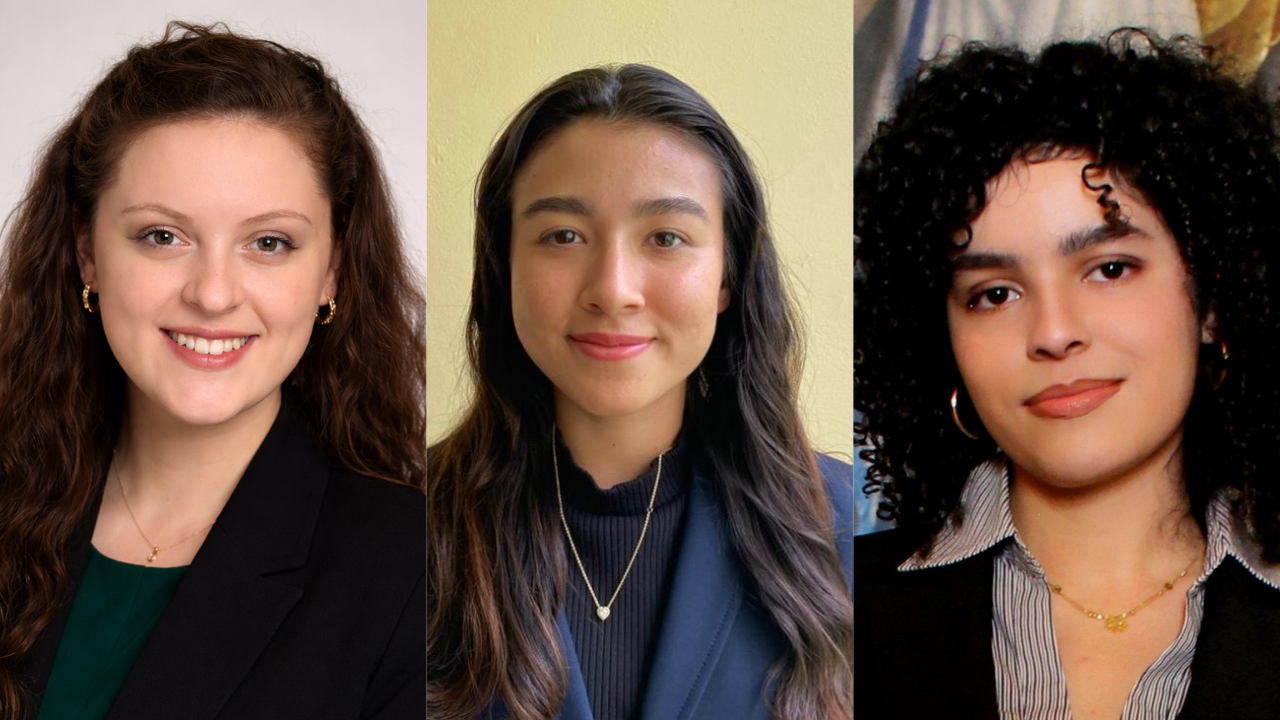
Photos courtesy of Isabella Pazmiño-Schell, Brigette Radilla Tellez, and Sophia Shahinaz Sarkies.
The Hispanic Pre-Law Review (HPLR) is excited to announce the recipients of three Writing Prizes. The recipients will be recognized on stage at the Hispanic Pre-Law Society’s Noche de Legado Gala on March 27.
These Prizes were awarded to Staff members who have published on our digital platform and produced, from start to finish, a piece with our Editorial Board. This year, there were more than 16 eligible publications that qualified for a Prize. Out of those 16, the HPLR Executive Team chose 2–3 to nominate in the following categories: Best Legal Opinion; Best Legal Opinion, Latin America; and Best Legal Research.
After the Executive Team nominated pieces, they were then reviewed by a Selection Committee with expertise in law, Latin America studies, and research. The Committee Members received via email an evaluation form that contained all nominated essays anonymized for their review. The numeric responses from this form were then averaged, and the winner was selected from these averages. Across all members, there was no tie and the Committee selected winners based on the authors’ legal argument.
This year, the HPLR Selection Committee was composed of the following members:
Alysha Acosta (CC '22), 1L at Columbia Law School
Catalina Rodriguez (CC '21), 2L at Columbia Law School
Mónica Alejandra Ramírez Bernal, Fulbright-García Robles Scholar and PhD Candidate and Teaching Fellow in Latin American Cultures at Columbia University
Kevin Funk, Fellow in Global Thought, The Committee on Global Thought at Columbia University; Lecturer, Columbia's Department of Political Science
Alexia Martinez, MA in Political Science Candidate at Columbia University
Best Legal Opinion, for the best article on a legal subject
Isabella Pazmiño-Schell (CC’28), Predictive Policing at the Border: How Algorithmic Immigration Enforcement Targets Latino Communities
In her piece, Isabella developed an original legal argument that analyzed the intersection of constitutional doctrine with emerging technologies in immigration enforcement. Her piece exceeds the highest standards set forth in HPLR's Editorial Guidelines, advancing the stakes in relation to her argument, and articulating broader constitutional implications.
Best Legal Opinion, for the best article on a Latin America subject
Brigette Radilla Tellez (CC’28), Changes to Mexico’s Amparo: What Can a Citizen Do When the Government Doesn’t Listen Anymore?
In her piece, Brigette situates her argument within the complex debate surrounding Mexico's recent judicial reform, focusing on one aspect of this reform, the "amparo," and larger implications for activists and journalists. Her piece exceeds the highest standards set forth in HPLR's Editorial Guidelines, advancing the stakes in relation to her argument and articulating the broader implications for Mexico and the Latin America region.
Best Legal Research, for the best use of research methods to analyze a legal subject
Sophia Shahinaz Sarkies (CC’29), The U.S. Patent Pro Bono Program and the Limits of Inclusive Innovation
In her piece, Sophia employs a literature review-based methodology investigating the social and institutional determinants of access to innovation, using the U.S. Patent Pro Bono Program as a case study to bridge this gap. Her piece exceeds the highest standards set forth in HPLR's Editorial Guidelines and advances an original research contribution that offers a new perspective on our understanding of the law.