
Bukele’s Broken Revolution
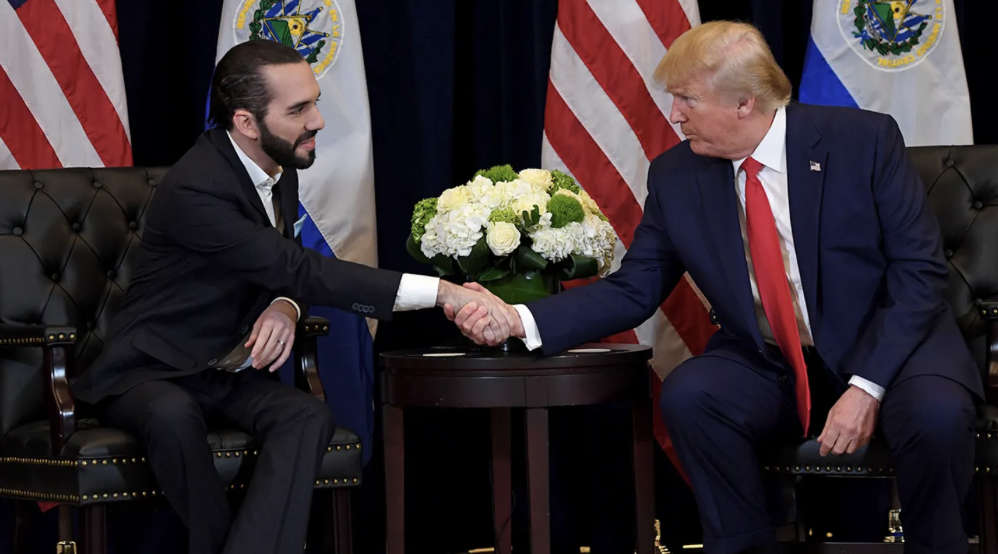
Photograph courtesy of Saul Loeb/AFP via Getty Images
“Siento un impulso irresistible, rompo la valla humana que me rodea, beso la criatura y le digo al oído: ‘¡Vencimos!’”
Those are the final lines of the book La Terquedad del Izote by Carlos Henríquez Consalvi, a rebel in the 1980s Salvadoran rebellion. The Stubbornness of the Izote (the national flower of El Salvador) highlights the blatant U.S. support for war crimes carried out by the Salvadoran military while rebels fought for a more just and independent El Salvador. The Salvadoran rebels succeeded in their war against the Salvadoran military and American imperialism. Today, however, Salvadoran President Nayib Bukele seems to have forgotten what was fought for in that rebellion, maintaining a close relationship with the United States, agreeing to imprison migrant deportees in the infamous maximum security prison named the Center for Terrorism Confinement (CECOT for its acronym in Spanish). Based on the framework laid out by the United Nations’ 1948 Universal Declaration of Human Rights (UDHR), specifically articles 5, 9, 10, 11, 12, and 20 of the declaration, international observers found that the conditions in CECOT and the manner in which arrests in El Salvador have been undertaken violated international law. In addition to Bukele’s collaboration with President Donald Trump, Bukele has also tightened his grip on power, dictatorially manipulating Salvadoran constitutional law.
Before Bukele’s election in 2019, El Salvador was experiencing among the worst violent crime in the world, with 103 homicides per hundred thousand people in 2015. During this period, Salvadoran presidential administrations conducted mass arrests and raids with little success, which, as a rising figure in Salvadoran politics, Bukele criticized as immoral and undemocratic. However, upon becoming President in 2019, one of his first acts was to threateningly march into the Salvadoran legislature flanked by military men to demand they approve his security budget. His threats to Salvadoran democracy did not stop there.
On May 5th, 2021, the Salvadoran legislature, which at the time was controlled by Bukele’s Nuevas Ideas party (or “New Ideas” in English), fired all five magistrates of El Salvador’s Constitutional Chamber, a branch of the Salvadoran Supreme Court which, according to article 174 in chapter III of the Salvadoran Constitution, determines the constitutionality of laws and presidential actions. The fired magistrates were replaced with ones sympathetic to Bukele, and one of the first things they did was completely annul Part 1 of Article 152 in Chapter III of the Salvadoran Constitution. This section states that a candidate cannot run for president if they were president “for more than six months, consecutive or not, the period immediately before.” Removing term limits was not enough for Bukele, however, and his next opportunity to tighten his grip on power came in early 2022.
Between March 24 and 27 of 2022, gangs in El Salvador allegedly killed ninety-five people. In response, the Nuevas Ideas-controlled Salvadoran assembly declared a “State of Exemption,” suspending numerous constitutional rights. According to Human Rights Watch, this resulted in the suspension of “the constitutional rights to freedom of association and assembly; privacy in communication; the rights to be informed of the reason for arrest, to remain silent, and to legal representation; and the requirement to bring anyone detained before a judge within 72 hours.” These rights are supposedly protected in Title II, articles 7, 24, 12, and 13 of the Salvadoran constitution.
Besides violating Salvadoran constitutional law, the Bukele administration has also broken international law through violations of human rights laid out in the United Nations UDHR. Specifically, the administration has violated articles 9, 10, 11, 12, and 20 of the UDHR. These articles protect persons from arbitrary arrest, ensure due process, assumption of innocence until proven guilty, privacy, and freedom of assembly respectively. According to numerous reports, the Salvadoran police and military have violated all of these. However, instead of listening to the concerns of the global community, Bukele simply restricted their ability to investigate human rights violations through the “Foreign Agents” law passed in May of 2025. This law was also passed in part because of an increase in foreign attention on the Salvadoran prison CECOT after an agreement between the Bukele and Trump administrations to send deportees from the United States to be held in CECOT. CECOT has been known for having deplorable conditions that violate article 5 of the UDHR: “No one shall be subjected to torture or to cruel, inhuman or degrading treatment or punishment.”
So why do the people of El Salvador not demand better from their government? Despite the human rights violations and authoritarianism, the reality is that the “State of Exception” was statistically successful, with El Salvador’s homicide rate dropping from 17.6 per one hundred thousand people in 2021 to just 2.4 per one hundred thousand people in 2024. Families from all across El Salvador have been torn apart because of the brutal violence that had prevailed throughout El Salvador prior to Bukele’s crackdown. No longer living in constant fear of a family member being lost at the hands of the gangs is one of the most impactful experiences the citizens of a country can have, and it is only natural that one would hold whoever was responsible for such an improvement in quality of life in very high regard.
However, even if things could be worse, policies that produce measurable security gains must still be evaluated against constitutional safeguards and international human rights standards. As a Puerto Rican, we tend to follow the same logic when electing our politicians purely out of fear that we will lose certain benefits instead of actual hope for a better, brighter future. We as Latin Americans should demand the very best, which means a safer and a more free, democratic, and prosperous country. The FMLN did not fight just for an authoritarian who thinks of himself as the “coolest dictator in the world” to consolidate power. The Izote is stubborn. It is not dead, perhaps just wilted. But with the will to power of the Salvadoran people, it can once again thrive.
Juan F Rosado Del Ríos (CC ‘29) is a Staff Writer studying Sociology and Latin American & Caribbean Studies. He is interested in Puerto Rican politics and the effects of American colonialism throughout Latin America.
Edited by Alessandra Diaz