
Political Marginalization of Indigenous Communities in Mexico
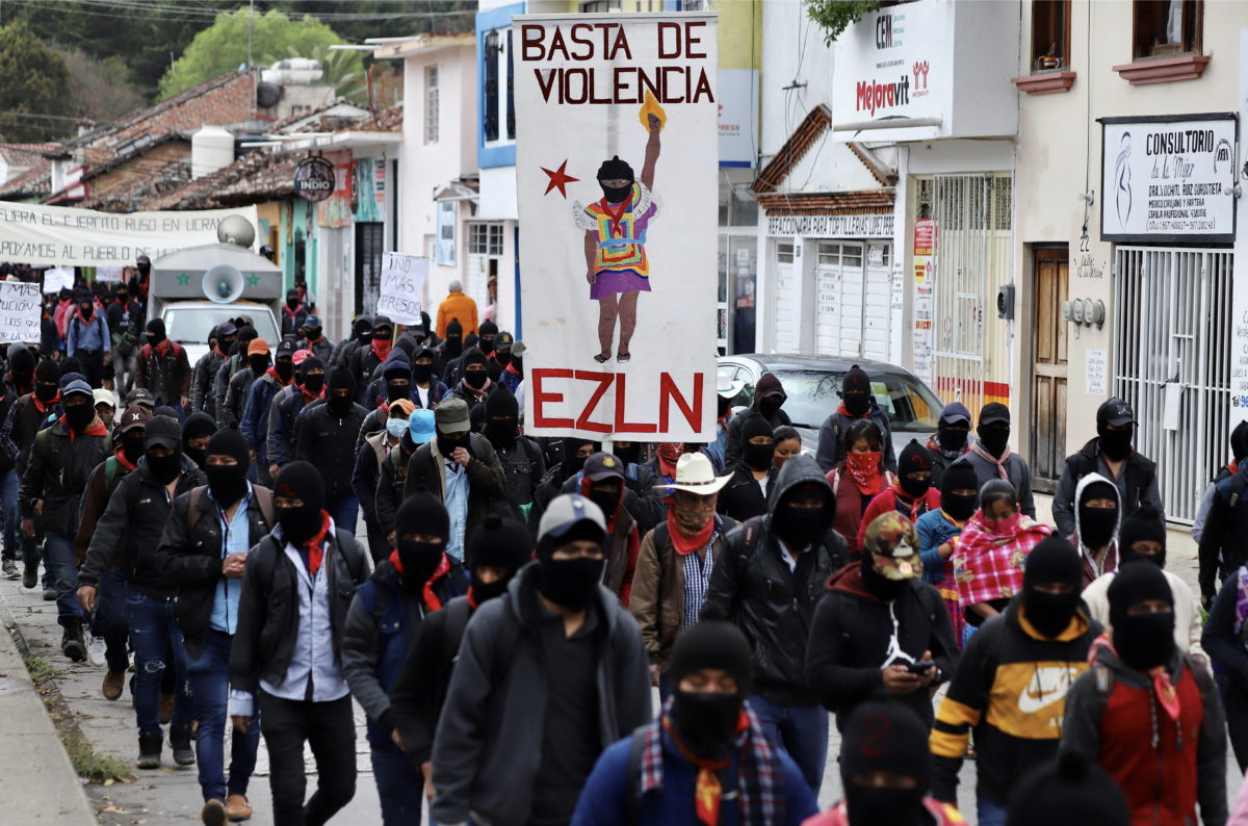
The Zapatista Army of National Liberation members march in San Cristobal de las Casas, Chiapas, Mexico, 2022. Photo by: Jacob Garcia.
Mestizaje, an ideology that has long shaped Mexican national identity, suggests that modern Mexican identity is formed by Indigenous and Spanish heritage, promoting the homogenization of the nation into a singular ethnic identity. By pushing for a movement of unification, Mexico has isolated Indigenous communities from political participation and repressed the native inhabitants of the nation. Thus, the ideology of mestizaje continues to function as an assimilative tactic that marginalizes Mexico’s Indigenous communities through repressive policy reforms. Specifically, the constitutional reform from Article 27 and the state’s refusal to pass the San Andrés Accords function as legal mechanisms that limit Indigenous autonomy under Mexico’s mestizo national framework. In response, Indigenous peoples have resisted in the form of political uprisings, cultural preservation efforts, and now, demands for autonomy.
Political scientist and historian Benedict Anderson asserts that, as a result of a decline in religion and the rise of the printing press, the idea that the nation is “imagined” emerged. In Mexico, mestizaje operates as an imagined community, promoting a singular narrative of Mexican identity and disregarding the centuries of colonialism and exclusion of Indigenous Mexicans–who don’t feel represented by this label–thereby creating alienation and resistance.
In the mid-1980s, President Carlos Salinas adopted a neoliberal turn in Mexico’s economic model that began to undercut the peasant position. The repeal of Article 27 of the Mexican Constitution, which had long governed land tenure in Mexico by mandating state-led redistribution, obliged the government to stop redistributing land to its rural population and instead shift toward market liberalization. Therefore, the rural poor began identifying with Indigenous communities–both groups subjected to repression–in an attempt to strengthen their political organizing. Perhaps most importantly, this reform raises a serious constitutional tension between market liberalization and the protection of land rights historically tied to the Indigenous community.
Mexico’s peasantry and Indigenous communities began to organize against the injustices in the form of a political uprising. In March 1992, Indians marched from Chiapas to the capital, Mexico City, to advocate for the modification of three regulations. They demanded “changes in agrarian reform in Article 27, which ignored Indians, the declining economic status of the rural Indian communities, and the exclusion of the Indians from the political process.” Article 27 had long declared that all land, water and mineral rights were the property of the people of Mexico. It allowed for the government to protect agrarian reform and communal land from being sold to large corporations. Angered by their disenfranchisement under economic and legal policies, Mexican Indians brought the peasantry and several tribes together to raise the domestic and international profile of Indigenous rights. This movement came to be known as “The Zapatista Movement” of 1994, led by the “Ejercito Zapatista de Liberacion Nacional (EZLN),” or the “Zapatista National Liberation Army,” named after Emiliano Zapata, a revolutionary leader and advocate for Mexican peasantry. The movement aimed not to change the government, but to confront the elites who made decisions on behalf of Indians without consultation. The government responded by attempting to turn the civilian population against and diminish the combativeness of the Zapatistas. However, the Zapatistas gained the support of the people and were able to bring about political change not through negotiation of the regulations, but the creation of autonomous municipalities. In this context, the uprising can be understood as a response to legal exclusion from established decision-making structures.
Despite the support garnered, the Mexican government was very reluctant to give the Zapatistas the political representation that they were fighting for. In 1996, the EZLN negotiated the passing of the “San Andres Accords on Indian Rights and Culture,” an agreement that gave Indians control over local governance, bilingual education, and natural resources. The Accords were discussed and approved by all representatives of the Indigenous communities in Mexico. However, President Ernesto Zedillo ignored the agreements and backed out at the last minute, increasing military presence in Chiapas instead.
When President Vicente Fox, leader of the National Action Party, took office in 2001, he promised to end the ongoing Zapatista conflict and renew peace talks with Indigenous communities by ordering Congress to withdraw military troops from Chiapas. Unfortunately, he refused to pass the previously agreed-upon San Andres Accords, just like Zedillo. Instead, he worked to pass the Congressional Chiapas Peace and Reconciliation Commission Bill (also known as the “Indigenous law”)—against the Zapatistas’ wishes. The bill, which is still in place today, “eliminated Indian autonomy at the national level but granted it at the local level, and the national government still maintained control over natural resources.” Despite changes in political parties and leaders, the Mexican government seems to have consistently refused to take into account the requests of the Indigenous communities in Mexico, the original owners of the land. Thus, discouraged and betrayed, the Zapatistas ceased negotiations for the entirety of Fox’s presidency, which lasted six years.
After the end of Fox’s presidency, the Zapatistas remained opposed to any future negotiation attempts with the Mexican government. Unfortunately, the Zapatistas did not fully achieve their main goal – to secure a voice for the marginalized peasantry and Indigenous peoples in Mexico’s political system. Nevertheless, they decided to build an independent, alternative group that developed 2,222 villages with a population of nearly 100,000 Zapatistas without accepting aid from the Mexican government. These communities include their own government councils and are run entirely by the community.
Despite the movement’s failure to pass the San Andres Accords, the Mexican government improved by offering free Indigenous textbooks in over 56 Indigenous languages and built schools throughout Indian communities where Indigenous leaders could teach children in accordance with their beliefs and history. However, the Zapatista municipalities continue to refuse any government assistance and are run entirely by their democratically elected leaders. Ultimately, mestizaje did not resolve ethnic conflict within Mexico. Instead, it enhanced and worsened cleavages that were already historically present and produced the resistance it sought to eliminate. By promoting a singular Mexican identity, the government treated Indigenous peoples as transitional or incomplete, rather than as autonomous beings and their way of life. Assimilationist policies in education and governance have repeatedly positioned Indigenous peoples as obstacles to progress, reinforcing marginalization rather than incorporation. Recognizing Indigenous autonomy requires thinking of Mexican national identity not as uniform, but as coexistence without assimilation. In other words, refusing to codify the San Andrés Accords shows that negotiated rights may remain politically acknowledged but legally unenforceable.
The historical trajectory of Indigenous resistance in Mexico and contemporary testimonies reveal an important shift in the political climate. The Zapatista Movement of 1994 sought to challenge state policies from within, demanding recognition, rights, and autonomy through negotiations with the government. Although the movement succeeded in drawing international and domestic attention to Indigenous struggles, the state’s continual resistance to honor agreements, such as the San Andres Accords, demonstrates the limits of inclusion within the mestizo state. Now, autonomy is a response shaped by historical betrayal and accumulated disappointment with state policies.
Alexa (CC’28) is a Staff Writer majoring in Political Science and Creative Writing. She is interested in public interest law and the marginalization of border communities.
Edited by Patricia Mayorga