
The Hidden Economic Toll of U.S.–Mexico Border Enforcement
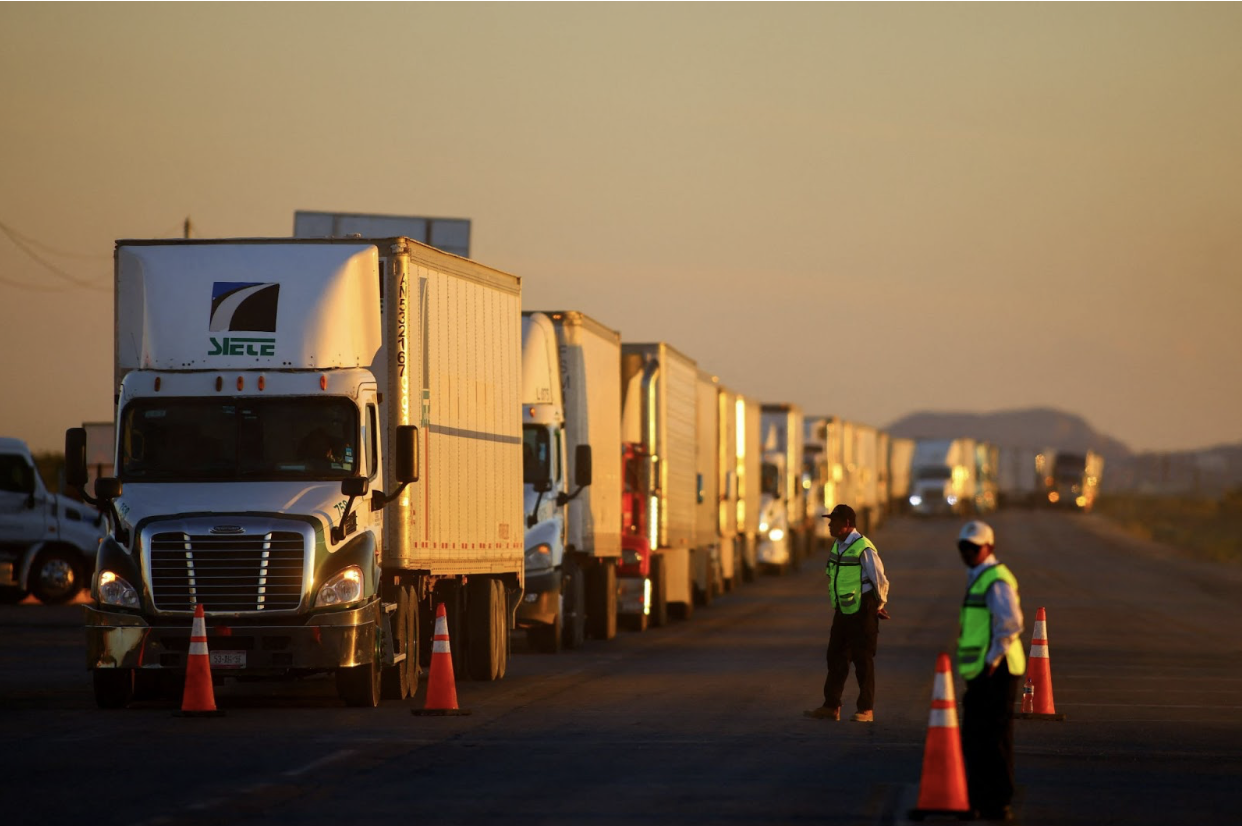
Trucks were left stranded on the Mexican side of the border after U.S. authorities shut down crossings and imposed extra security checks amid an increase in migration. Photo by Jose Luis Gonzalez/Reuters.
Since his inauguration, the Trump administration has pursued a multifront campaign to secure the U.S.–Mexico border by targeting drug cartels, transnational criminal organizations, and unauthorized migration. These efforts included the deployment of military personnel, stricter interrogation and inspection procedures at ports of entry, and expanded coordination with Mexican authorities. While these measures were designed to advance legitimate security objectives, they also produced economic consequences for border communities, including prolonged wait times at ports of entry and disruptions to cross-border labor mobility, resulting in delays in commercial trade.
Intensified enforcement practices at major ports of entry operate not only as migration control but as a form of economic governance. By shaping wait times, mobility, and processing capacity at ports of entry, enforcement policies function as economic constraints whose costs are unevenly distributed across border populations. In my analysis, I do not challenge the legitimacy of border security or the importance of combating drug trafficking and unauthorized entry. Rather, some enforcement strategies, while designed for security, also create economic burdens. These costs fall disproportionately on border populations and are often overlooked in policy debates, even though research shows that inspection regimes can significantly delay legitimate travel and freight.
The Migrant Protection Protocols (MPP), commonly referred to as the “Remain in Mexico” policy, were first introduced in 2019 as a mechanism to manage asylum claims by requiring certain non-Mexican asylum seekers to await their U.S. immigration proceedings in Mexico. Individuals who were issued notices to appear in court were returned across the border and required to report to designated ports of entry for hearings scheduled weeks or months apart, often being sent back repeatedly while their cases remained pending. As a legal matter, the MPP did not formally suspend the right to apply for asylum; instead, it altered the geographic location in which asylum seekers were required to wait while their claims were adjudicated. In practice, this alteration produced prolonged stays near ports of entry, where limited access to legal representation and repeated court appearances concentrated large populations in already high-traffic areas. As a result, cities such as Reynosa were transformed into semi-permanent holding spaces, with sustained congestion and delays affecting both migrants and the broader cross-border movement of people and goods.
This accumulation was not an unintended byproduct of enforcement but a foreseeable outcome of policies that concentrated large populations near ports of entry while prolonging the resolution of asylum claims. In this instance, congestion is not incidental to enforcement but is built into the structure of the MPP.
The economic consequences of these dynamics become clear when examining delays at major crossings. In early 2025, operations at the Pharr–Reynosa International Bridge were significantly disrupted by a technical failure in Mexico’s customs system, forcing authorities to adopt contingency procedures that slowed processing capacity. Backlogs quickly formed, with hundreds of trucks delayed per hour and some drivers waiting more than 24 hours to cross. Given that thousands of shipments move through this corridor daily, even short disruptions translate into substantial congestion and economic losses across supply chains.
While a technical issue triggered this disruption, its effects were magnified by already strained inspection regimes and high border traffic volumes. In such contexts, even marginal increases in inspection intensity or administrative burden can produce cascading delays. These delays affect not only commercial freight but also students commuting to school, workers traveling to jobs, and residents engaging in routine cross-border activities.
Border enforcement operates as a “hidden tax” on lawful movement. Unlike traditional taxes, these costs are not collected through formal charges but through time: hours spent waiting in line, lost wages, missed work opportunities, and increased transportation expenses. For cross-border commuters, these cumulative burdens function as a daily economic penalty imposed by enforcement-related congestion.
From a labor economics perspective, these policies also act as constraints on labor supply. By delaying or restricting the movement of individuals across the border, enforcement reduces the short-term availability of cross-border labor in sectors that rely heavily on it. In highly integrated regions such as the Rio Grande Valley, where economic activity depends on routine mobility, these constraints can suppress productivity, disrupt business operations, and slow regional growth. At the same time, delays at commercial crossings disrupt just-in-time supply chains that underpin U.S.-Mexico trade, meaning that localized enforcement decisions can have broader economic effects across national and transnational markets.
Enforcement policies also reshape labor markets on the Mexican side of the border. In cities such as Reynosa, prolonged restrictions on entry into the United States concentrate large populations near ports of entry. Over time, many migrants enter the informal labor market under precarious conditions, contributing to local economies while lacking access to stable wages or legal protections. In this way, enforcement does not eliminate labor supply but redirects it, reshaping local labor dynamics in regions least equipped to absorb it. As a result, border cities absorb the immediate social and infrastructural costs of enforcement-driven containment, while the long-term economic benefits of migrant labor remain concentrated in U.S. labor markets once entry becomes possible.
The effects in labor markets extend across the border. By delaying migrants’ entry into the United States, enforcement policies postpone their participation in formal labor markets and the income streams that fund remittances. In regions, such as the Rio Grande Valley, where immigrants account for a significant share of the workforce and contribute substantially to regional economic output, disruptions to labor mobility function as economic frictions that affect both production and consumption.
Implementing more effective measures to accelerate border crossings for private vehicles, commercial trucks, and pedestrians would help mitigate the economic disparities of delayed wages, lost hours, and transportation expenses. Investments in port-of-entry infrastructure, staffing, and technology could significantly reduce wait times. However, if such improvements are financed through higher crossing fees, the cost would ultimately fall on the very commuters and workers who rely on daily mobility. When congestion results from federal enforcement decisions, such as heightened inspection intensity or reduced processing capacity, the burden of mitigating those delays should not be shifted onto cross-border users. As a matter of administrative law and public finance, regulatory costs are generally expected to align with the governmental policies that produce them rather than being imposed on third parties who are not the source of regulatory risk. These effects raise administrative law questions about the distribution of regulatory burdens and whether enforcement practices impose outsized costs on populations that were not the intended targets. Reducing border congestion, then, is not simply a matter of administrative efficiency but a question of governance: legislative and administrative decisions regarding port-of-entry staffing, inspection procedures, and infrastructure investment shape how people and goods move through ports of entry, functioning not only as security measures but also as a form of economic regulation affecting integrated border regions.
Border enforcement and economic regulation are not separate domains. When federal decisions on inspection intensity, staffing levels, and processing capacity result in measurable delays, lost wages, and disrupted supply chains, those decisions function as economic policy regardless of how they are framed. The “hidden tax” imposed on cross-border commuters, workers, and commercial carriers is not an incidental byproduct of legitimate security objectives; it is a distributional outcome of governance choices that have gone largely unaccounted for in policy deliberations. Treating these costs as externalities, burdens absorbed quietly by border communities while the benefits of enforcement accrue elsewhere, reflects a structural asymmetry that administrative and legislative actors are positioned to address. Recognizing port-of-entry policy as a form of economic regulation is a prerequisite to designing enforcement frameworks that take seriously not only who crosses the border, but what crossing costs.
Brigette Radilla (CC’28) is a Staff Writer majoring in Economics and Latin American & Caribbean Studies. She is interested in the intersection of policy and economics, particularly in the context of the United States and Mexico.
Edited by Liana Marks