
The Inherent Legal Ambiguity of H-2 Visa Workers and its Repercussions
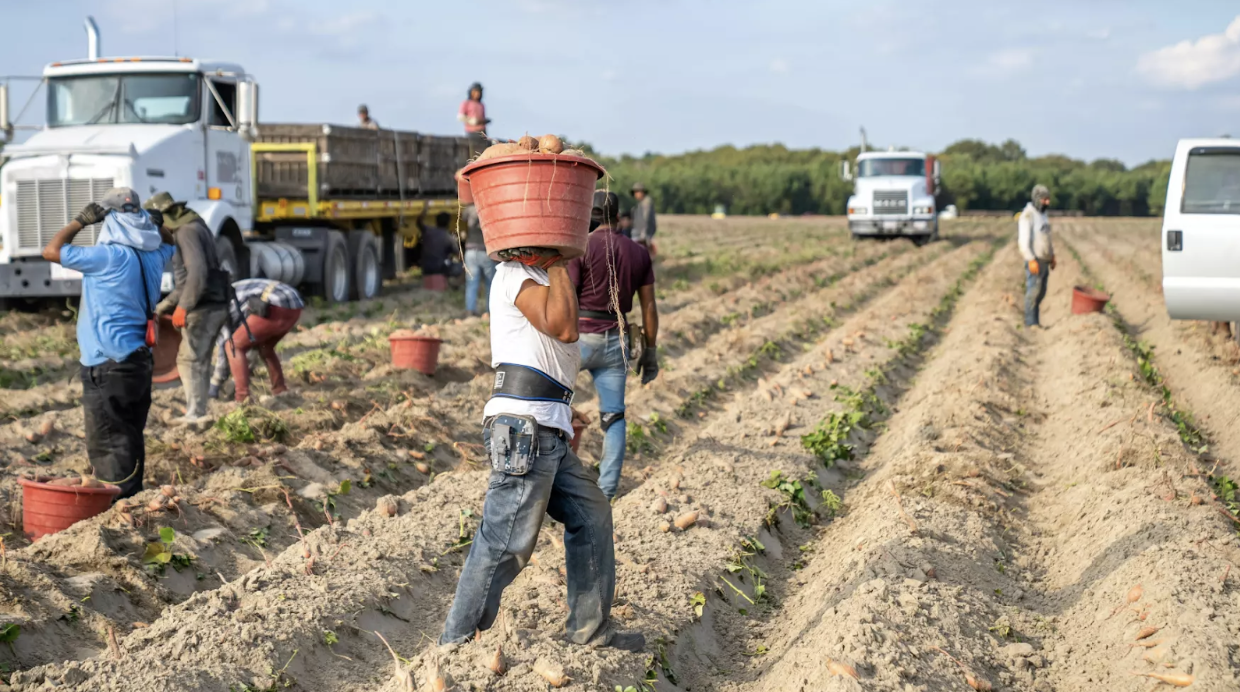
Mexican farmworker carrying a basin full of sweet potatoes in North Carolina, 2025. Mark Stebnicki, Pexels.
On January 30th, 2025, the Department of Homeland Security (DHS) and Department of Labor (DOL) announced they would temporarily increase the permitted number of H-2B visas from the annual 66,000 cap to an additional 18,490 for the 2026 fiscal year. In light of the mass deportation programs enacted by the Trump Administration in 2025, the expansion of H-2B visas might seem like a way to secure legal status for immigrants. However, workers participating in the H-2 Visa Program, whether through H-2B or H-2A visas, have often been victims of limited legal protections due to questions of jurisdiction, generating a lack of judicial oversight and individual autonomy. These gaps in legal protections have resulted in negligence, which will continue to occur under the expansion of the program unless reformed. This right-remedy gap supports how, while it might seem like this temporary legal status would be beneficial to particularly some Latine immigrants, the legal ambiguity inherent in the H-2 Visa Program leaves workers vulnerable to limited protections under constitutional and international human rights law.
In 1986, the Immigration Reform and Control Act amended the Immigration Nationality Act of 1952 (INA), creating the H-2 Visa Program to provide visas for temporary, seasonal workers. The program has allowed U.S. employers to apply to bring “foreign nationals,” overwhelmingly Latin Americans, to the United States on work visas to fulfill labor demands. Specifically, the H-2A visa is given to workers in the agricultural sector, while the H-2B visa is used by a diverse array of industries, including hospitality, groundskeeping, food processing, construction, forestry, and recreation. Within the past decade, the number of H-2A visas alone has more than tripled, with 258,000 being issued since 2021. Similarly, H-2B visas have rapidly increased, going from 88,000 in 2021 to 130,716 in 2023.
According to the INA, upon filing for the H-2 visa, the employer commits themselves to offering “the same benefits, wages, and working conditions,” upholding the standard enforced by the U.S. government. To fulfill this requirement, H-2 employers must provide no-cost housing, access to a kitchen or meal plan, and transportation.
The ruling from the 2025 U.S. Third Circuit Court of Appeals case, Sun Valley Orchards LLC v. The United States Department of Labor, exemplifies how, despite their legal status and vital contributions to the U.S. economy, their status as non-citizens leaves workers vulnerable to abuses by employers, as supported by the following offenses against workers.
Sun Valley Orchards, a New Jersey farm containing fruits and vegetables, first participated in the program in 2015 and employed a total of 96 immigrant workers through advertisements promising compliance with H-2 employment regulations. However, that same year, the DOL agency investigators would come to confirm, through “hundreds of thousands of dollars in civil penalties and back wages,” that they committed several job order violations.
The housing provided by the employer had missing screen doors, no bed frames, and lacked hot water. The vehicles used as transportation, to and from job sites, had “insufficient tread on the tires for safe operation,” one DOL report states. Moreover, the employer not only failed to provide meals or kitchen facilities, but actually started charging workers for meals without notice. Sun Valley Orchards would later argue that their charges could be boiled down to “paperwork” issues.
Ultimately, the court ruled that, despite the “appearance of a common law contract action,” they could not hold Sun Valley Orchard culpable in the case, which was “really about immigration,” in the jurisdiction of the executive branch under Article III of the Constitution. This ruling exemplifies how the victims’ immigration status legitimized limited legal protections.
But rather than a common law contract action, Sun Valley Orchard’s actions constitute a case under constitutional law for their violation of the Thirteenth Amendment. This amendment states that “Neither slavery nor involuntary servitude…shall exist within the United States.” Involuntary servitude, as described by the Department of Justice through Section 1584, is a condition by which a person is compelled to work “against his/her will by creating a ‘climate of fear’ through the use of force, the threat of force, or the threat of legal coercion.”
H-2 workers, like those of Sun Valley Orchards, are compelled to submit to the demands of abusive employers because they face significant socioeconomic barriers and are dependent on employment for legal immigration status. Once an H-2 worker’s employment is discontinued, their immigration status is no longer protected, leaving them susceptible to orders for deportation. Furthermore, seeking assistance when faced with degrading treatment by employers is made difficult by workers’ limited education, English language proficiency, and access to technology. The legal ambiguity of H-2 workers, coupled with socioeconomic barriers, makes justice in the U.S. legal system theoretically possible, yet practically unattainable.
However, this negligence by the U.S. legal system is not just a disregard for immigrant workers’ rights but also for international human rights law. The International Covenant on Civil and Political Rights (ICCPR) was initially adopted by the United Nations in December of 1966 and signed by the United States in 1992. Given that this differential treatment towards H-2 Visa workers is not proportional or necessary for a legitimate aim, limited freedom from forced labor, freedom from degrading treatment, and the right to trial are illegitimate human rights abuses. However, international human rights frameworks inherently link protections to the enforcement of the state by which individuals reside, widening the gap between legal and practical distance to justice.
As a result, H-2 visa workers are faced with legal ambiguity under both constitutional and international human rights law. Under international law, immigrant workers are entitled to protection by the U.S., while current precedent illegitimately permits differential treatment. As long as these protections remain unclear, Latine immigrant workers in the H-2 program will continue to face the injustice uncovered by Sun Valley Orchards v. United States Department of Justice. Consequently, civil and labor rights advocates must meet the expansion of the H-2 program with caution, recognizing that a legal status alone does not guarantee equal and adequate protections for H-2 visa workers; instead, it creates an opportunity for this marginalized community to be taken advantage of.
Kimberly (CC’28) is a Staff Writer majoring in Political Science. She is interested in labor rights, economic inequality, and political behavior in democratic governments.
Edited by Emelin Brito