
The Bukele Trap: Security and the Demand for Repression
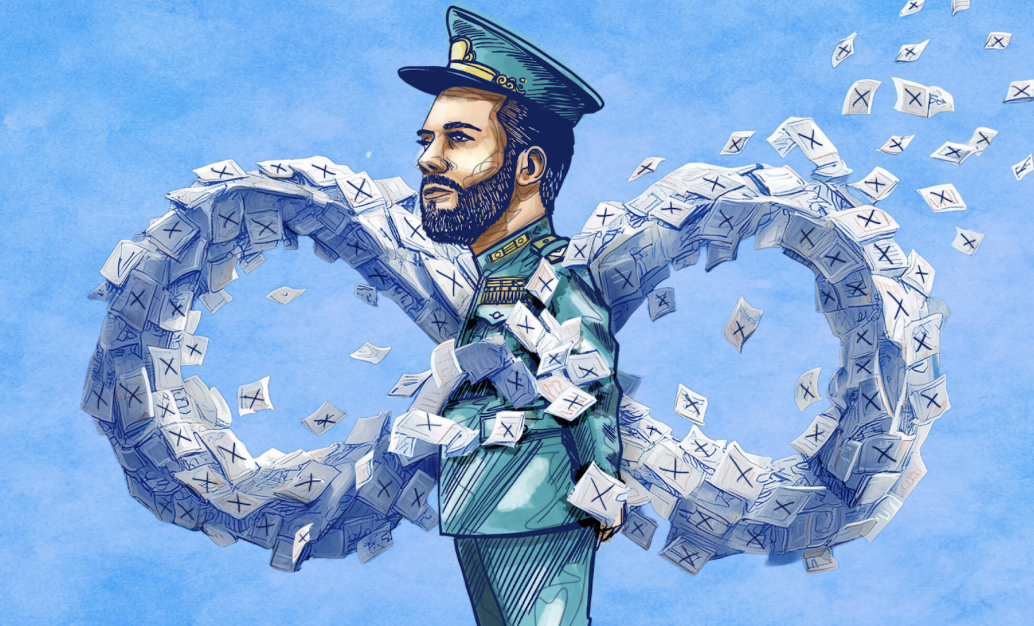
Nández, César. Illustration of Nayib Bukele with papers forming an infinity symbol. Latinoamérica21.
Nayib Bukele has become a highly admired figure on the global stage following his notable crime reduction successes and subsequent landslide reelection in 2024. The consecutive two-term president has seemed to meet the demand of long-awaited change made by citizens victimized by corruption and crime in El Salvador. However, successful change can often be accompanied by a troubling idealization of its leader, risking the trade of one flawed reality with another. This dynamic reveals a particularly salient pattern: individuals exposed to high levels of victimization are more willing to tolerate human rights erosion and democratic backsliding in exchange for the promise of safety. In the case of El Salvador, this helps explain why Bukele continues to attract popular support despite well-documented disappearances, arbitrary detentions, and the suspension of habeas corpus under the nation’s perpetual state of emergency. Bukele is not the first Latin American leader to adopt such authoritarian strategies, but his rise as the “cool dictator” should serve not as a model met with admiration but as a cautionary example for Latin American countries facing similar security crises and thus vulnerable to the same authoritarian trap.
In 2019, Bukele ran for presidency with the Grand Alliance for National Unity party (GANA), winning 53.4% of the popular vote and becoming the first elected president in years who did not belong to either of the nation’s two largest political parties, Farabundo Marti National Liberation (FMLN) and the Nationalist Republican Alliance (ARENA). The efforts employed by the previous administrations, particularly through “iron fist” and “gang truce” policies, failed to decrease crime victimization at the same level it rose. At its peak, 50% of homicides in El Salvador were due to gang violence. Bukele’s advertised zero tolerance approach to gang violence, coupled with his branding as a new model of governance, both in terms of distinct party identification and policy, succeeded in addressing public frustration by providing measurable results. In fact, homicides decreased from 2,398 in 2019 to 114 in 2024. Statistically, Bukele’s model is successful.
The results, however, are achieved at the cost of extensive human rights violations, particularly in relation to the American Convention on Human Rights (ACHR) and the International Covenant on Civil and Political Rights (ICCPR). To rise in power and enact legislation without the approval of the Legislative Assembly, Bukele enacted a state of emergency in 2022, suspending normal constitutional and international protections to restore order in response to gang violence. While a temporary provision, El Salvador is still in a state of emergency today. In doing so, Bukele has consolidated power and reinforced it through constitutional restructuring, most notably by ending the ban on presidential reelection that enabled his 2024 run. In addition, he led the dismissal of dozens of government officials, engaged in covert deals with El Salvador’s major gangs to reduce homicide rates in exchange for improved prison conditions, and deployed Pegasus military-grade spyware to surveil El Faro, a popular newspaper, and other journalists.
Most notably, a decrease in crime has been followed by an increase in arbitrary mass detentions and detainee abuse. More than 85,000 individuals have been detained, at least 20,000 with no evidence of their association with gangs including journalists and human rights organizations, held without access to outside contact or a trial. In fact, many officers testified they were instructed to “Go out and detain five people,” engaging in “detain first, investigate later” practices to prevent punishment. The prison population increased from 36,515 in 2021 to more than 107,055. Inside prisons, detainees undergo beatings by prison guards, lack basic necessities such as food, water, and sanitation, are exposed to tear gas in cells, and are victims of enforced starvation. Many similarly described the scars from such conditions, which became “a constant reminder of the horror [they] lived.” Lawyers are prevented from entering prisons, and families receive little to no communication on the detention of their loved one or a notification of death. The arbitrary detention and arrest of individuals is in violation of ICCPR Article 9, and reports of abusive prison conditions violate Article 10’s protections for the humane treatment of detainees. Bukele’s new model of governance thus reframes security not as a protection of rights, but as a justification for their suspension.
This environment is particularly evidence in the erosion of judicial protections. Article 25 of the American Convention on Human Rights guarantees individuals the right to judicial protection when their rights are violated, while Article 7(6) ensures that detainees can challenge the grounds of their imprisonment before a court, otherwise known as habeas corpus. In an advisory opinion about the interpretation of the two articles, the Inter-American Court of Human Rights held that habeas corpus can not be suspended, even in a state of emergency, as it is essential in determining the lawfulness of a detention and in protecting against disappearances and inhumane or cruel and unusual punishment. In addition, the International Group of Experts for the Investigation of Human Rights Violations under the State of Exception in El Salvador (GIPES), ruled in March 2026 there are reasonable grounds to conclude El Salvador is committing crimes against humanity within a public security policy framework, warning the nation’s human rights violations threaten the very security it advertises to protect.
And yet, despite widespread human rights violations, Bukele continues to enjoy popular support, both domestically and across Latin America. This support reflects a broader pattern: political leaders who adopt punitive appeals are often rewarded electorally when those they govern are highly victimized and exposed to severe violences, increasing their preferences for harsher punishments. In countries like El Salvador, where crime and corruption have long shaped daily life and previous, less punitive measures have failed, security becomes the most pressing, immediate, and lived concern. As a result, citizens increasingly support policies that prioritize security over preserving democratic values, freeing them from pervasive harassment, extortion, and violence by gangs. This reduced support for democracy, leads to an increased tolerance for repression, becoming a condition of and conduit for violence. Leaders like Bukele exploit these conditions by making promises of quick and punitive crime reduction. This model is especially dangerous and effective, when such measures like in El Salvador produce immediate and visible results that allow citizens to reclaim their homes without fear.
This pro-Bukele support creates a tempting and self-reinforcing trap. Bukele’s punitive policies have succeeded in reducing crime on a large scale, but he has done so by placing El Salvador under a state of emergency, illegally suspending habeas corpus and leaving thousands vulnerable to extreme abuse. Democracy is fragile, and security tactics have long been used to justify backsliding into an authoritarian regime. There should not be a choice between fundamental rights and public security. Yet, as more nations confront insecurity, leaders will turn to Bukele's playbook to share in his success. The “Bukele Trap” is not simply the erosion of human rights in exchange for security, but the normalization of authoritarianism as an acceptable model of governance when repression is rewarded politically and produces results. What was once an exception becomes a blueprint.
Sofia (BC ’27) is a Staff Writer majoring in Political Science. She dedicates herself to advocating for immigrant communities by examining and addressing the policy and legal barriers that limit their access to opportunity.
Edited by Gabriella Casey Garrido