
What the Dominican-Haitian Conflict Reveals About the Future of the United States
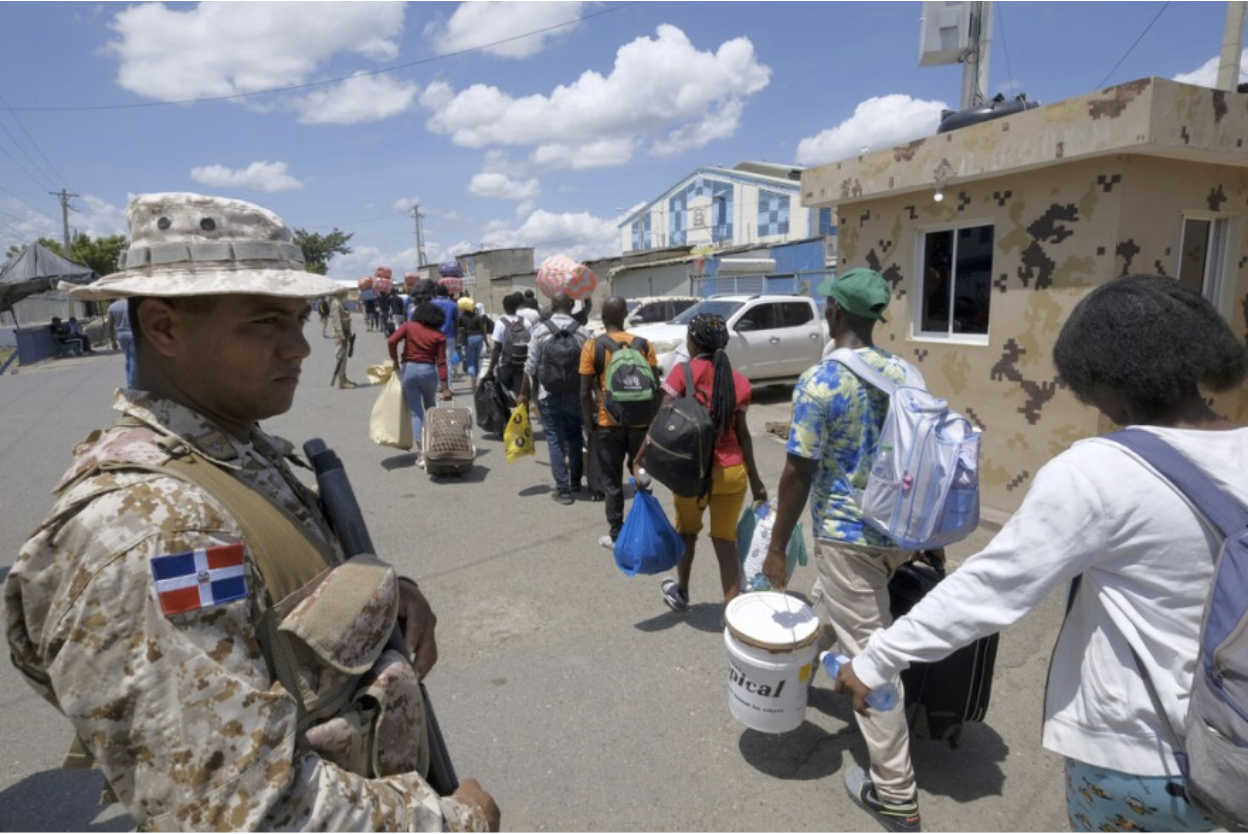
A Dominican security soldier stands supervising a border bridge between Dajabón, a town in the Dominican Republic, and Haiti. Photography by Ricardo Hernández.
The Dominican Republic has spent nearly two centuries building a legal, political, and social framework designed to exclude its Haitian population. That same framework produced the 1937 Parsley Massacre, in which an estimated 20,000 Haitians were killed under Dominican Dictator Rafael Trujillo. It produced a 2013 judicial ruling that stripped hundreds of thousands of Dominican-born people, with Haitian ancestry, of their citizenship overnight. It has produced detention camps that have been condemned by international human rights organizations. It has even resulted in a pledge by the current Dominican president to deport 10,000 Haitians every single week. This environment is what state-sanctioned xenophobia looks like when it’s allowed to fester and mature without strong legal or political resistance. Every American should be paying close attention as the Dominican policies that have resulted in such a devastating conflict are similar to the ones the Trump Administration is implementing. The Dominican Republic’s century-long campaign of anti-haitianismo (anti-Haitianism) provides a blueprint for how immigration rhetoric slowly becomes immigration law, and how immigration law becomes state violence.
The Dominican Republic declared its independence in 1844, not from Spain or some other European imperial power, but from Haiti, which had governed the island since 1822. The beginning of Dominican national identity was already constructed through Haitian opposition. A ruling class was already forming that was deeply invested in anti-Blackness and anti-Haitianism. This was not accidental–it was a political project seen throughout various Dominican leaders that defined what a Dominican was, by highlighting what a Dominican was not.
By the time Rafael Trujillo consolidated power in 1930, anti-hatianismo had already been simmering for years. Trujillo had brought it to a boil. The 1937 Parsley Massacre was the most gruesome form of anti-hatianismo, where soldiers discerned who was Haitian by asking them to pronounce the Spanish word for parsley, perejil, since it was hard for Haitians to emulate the trill of the Spanish “r.” The soldiers killed those whose Creole accent gave them away. The International Association of Genocide Scholars claims that the key prerequisites for mass murder include, “the existence of a stigmatized racial/ethnic minority group within the dominant society, the political and economic disenfranchisement of that minority group, and the historical precedent of state-sponsored mass murder.” The Dominican Republic has progressed throughout the prerequisites by placing Haitians as the stigmatized racial and ethnic minority group, disempowering them through lack of due process, political and economic support. Through Trujillo, the country marked historical precedent of state-sponsored mass murder. Anti-Haitianism had solidified itself as part of the Dominican culture under Trujillo and it would outlive him by becoming embedded in institutions and a national identity that required Haitians to be the scapegoat.
Haitian discrimination evolved with the 2013 Constitutional Ruling TC/0168/13 that retroactively stripped birthright citizenship from anyone born to foreign parents, by ordering the government to “transferir administrativamente los nacimientos que figuran en la Lista de extranjeros irregularmente inscritos en el Registro Civil de la República Dominicana a los nuevos libros-registros de nacimientos de extranjeros” (“administratively transfer the births listed on the Registry of Foreigners irregularly registered in the Dominican Civil Registry to the new foreign birth registries”), reaching back to 1929 and rendering thousands of people stateless overnight without individual hearings or due process. This ruling targeted Dominicans of Haitian descent. Dominican President Danilo Medina then introduced Law No. 169-14, on May 23, 2014, as a supposed remedy for those affected by the 2013 Constitutional Tribunal Ruling. However, the program was designed with such strict documentation and registration requirements that many affected families lacked or could not complete within the deadlines, leaving very few able to qualify.
This evolution most recently has shown itself through the Dominican President Luis Abinader’s pledge in his address to the United Nations, where he stated his goal to deport 10,000 Haitians per week. This pledge has resulted in the detainment of Haitians with valid work permits, legal residency, and even Dominican citizenship without hearings and with their documents confiscated or ignored. The detainment camps where they place large numbers of Haitians and even Dominicans, have been condemned for the denial of basic necessities. Throughout Abinader’s presidency, due process has been discarded in order to reach the large quota. For example, Haitian flight student Louis Jerry Wood, who had valid immigration documents including a work and study permit, was detained by authorities despite showing proof of his legal status. In this case, his due process was completely disregarded, and his case is definitely not a unique one. To the Dominican soldiers and immigration enforcement, legal status matters less than skin color and national identity.
Similarly, the parallels to the current United States are clear with the executive orders, detention records, and the death toll under the Trump Administration’s policies. On the first day of his second term, President Trump signed Executive Order 14160, seeking to end birthright citizenship in the United States. This executive order was challenged by Trump v. Barbara, where all of the lower courts ruled the executive order as unconstitutional, and the case is now awaiting a Supreme Court decision. Birthright citizenship is a right guaranteed by the Fourteenth Amendment since 1868. The Dominican Republic had a successful attempt through its Constitutional Tribunal in 2013, which the United States seems to be following in their footsteps. For instance, like Dominican President Luis Abinader established a deportation goal, so did Trump, but to an even larger scale. The Trump administration has pledged to deport one million people annually, which is double Abinader’s already large goal. Such a number almost requires the elimination of individual legal review, and this has been seen with the detainment of countless legal permanent residents. What happened to Louis Jerry Wood in the Dominican has been seen in the US with examples like Kilmar Abrego Garcia, an immigrant from El Salvador who was deported in March of 2025 after living in the United States for almost 15 years, even after being granted protection from deportation by a judge years prior.
The Dominican Republic’s detainment camps did not simply become sites of abuse because individual officials were especially cruel. They became this way because the political culture had, over generations, defined Haitians as people to whom natural protections did not apply. The dehumanization of the Haitian people and more widely, Black people, prompted the deprivation of their human rights in the Dominican Republic. When American officials describe undocumented immigrants as criminals, and when enforcement targets Latino and POC communities regardless of legal status, they are reproducing the same political culture that allowed for such atrocities in the Caribbean. Following the prerequisites for mass murder suggested by The International Association of Genocide Scholars, the United States is making its way down a similar path as the Dominican Republic, by stigmatizing, disenfranchising, and excluding Latino and other POC groups. The Dominican Republic did not arrive at these violations in a single moment, but through years of accumulated precedent. The United States is placing the building blocks through the violence of ICE, with at least 11 people having already died under ICE custody from January to early March of 2026.
The conflict between the Dominican Republic and Haiti is a case study of what happens when a government is allowed to define a group of human beings as outside the protection of the law. We have the advantage of seeing the pattern, while it's still forming. When the law stops protecting some of us, it eventually stops protecting all of us. We need to look at what is happening now in the United States not as a simple debate about immigration policy, but as the systemic legal dismantling of the rights of an entire group of people. The time for action is now, before the 11 become 110, and before xenophobia is instilled as one of the values of the United States.
Gabriel (CC’29) is a Staff Writer majoring in Linguistics. He is interested in the politics of language and raciolinguistic ideologies in government.
Edited by Carolina Muñoz