
Discontinued Language Services and Due Process Violations: Immigration Proceedings in Trump’s Era
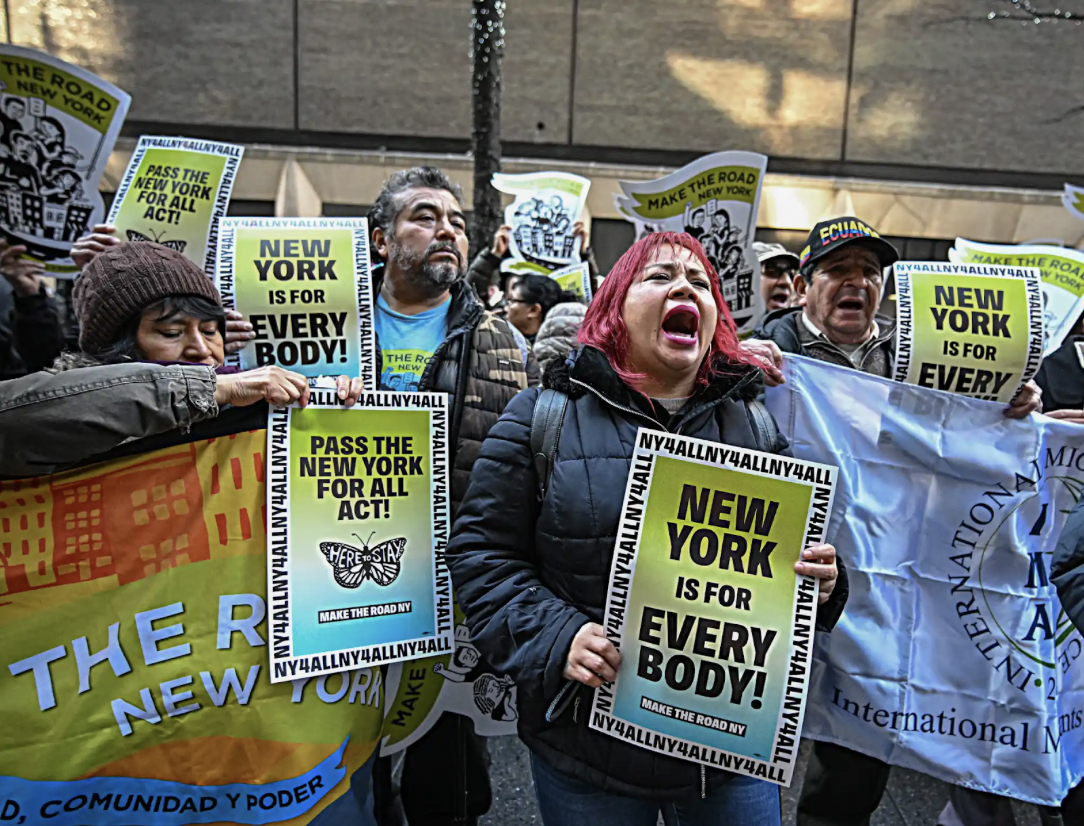
Advocates protesting in front of New York State Governor Kathy Hochul’s Office. Photo by Dean Moses, AMNY.
Immigration proceedings have the potential to derail someone’s entire life, and oftentimes, immigrants are forced to navigate the system without language services or legal assistance. Due process, a constitutional right, is not being followed during immigration proceedings. In legal proceedings, due process encompasses certain rules that need to be followed, like legal representation, notification of your detention, and the opportunity to defend yourself. English-only policies are stripping immigrants of access to translation services during immigration proceedings, but this is only one aspect of a broader due process concern. The more fundamental crisis is that immigrants facing removal have no guaranteed right to counsel appointed by the government, even as they are treated like criminals in the legal system.
For the more than 47 million immigrants living in the United States, the language barrier has historically been an obstacle, whether in social interactions or government dealings. Nevertheless, the United States has been considered a melting pot of cultures and languages. This changed on March 1, 2025, when English was designated as the official language of the United States through presidential Executive Order 14224. This order led to changes in government procedures at both the state and federal levels, marking a stark difference from the past, when diverse languages were championed. One of these changes occurred in Florida, which became the first state to require driver’s and commercial license exams to be conducted in English with no translation services, even though over 30% of Florida households don’t use English as their primary language. At the federal level, United States Citizenship and Immigration Services (USCIS) suspended language interpretation for field office appointments, including interviews for naturalization and asylum applications. During immigration removal proceedings, interpreters are often inaccurate, uncertified, and unavailable.
Even more alarming, however, is the limited access immigrants have to representation. Although having an attorney might seem like a procedural formality, the data suggests otherwise. In New York City, 67% of detainees were unrepresented, compared to the 21% of non-detained individuals, a discrepancy of 46%. In the United States, 62% of immigrants without an attorney were deported, but the percentage drops to 27% for those with legal representation, demonstrating how crucial it is to have legal representation in removal cases. It is important to note that most of those detained have no experience with the legal system; as of January 2026, the number of detainees with no criminal record has increased by 2,450%. Financial barriers pose an obstacle for representation, as immigration attorneys can charge up to $700 an hour. This urgency is evident when considering recent changes to the immigration system, namely the pretermission of asylum cases. Pretermitting a case means the judge can deport the applicant before their evidentiary hearing if they find the applicant lacks sufficient evidence to demonstrate their need for asylum. Under Asylum Cooperative Agreements, applicants who arrived in the United States after November 18, 2019, are subject to deportation to countries such as Guatemala, Uganda, or Honduras, even if these are not their country of origin. Oftentimes, pretermission is difficult to fight without the guidance and legal advice of an attorney, as evidentiary hearings require very specific evidence. Applicants are even cross-examined by a DHS attorney, oftentimes forced to represent themselves, or pro se. Despite the evident importance of legal representation for individuals in immigration proceedings, the judicial system lacks a constitutional framework to enforce this as a legal right.
Even though the Sixth Amendment declares that people have the right to an attorney, it was Gideon v. Wainwright that ruled that an attorney is appointed by the government, even if the individual cannot afford one, during felony proceedings. Despite this, immigration cases do not fall under the Sixth Amendment because they are considered civil administrative proceedings rather than criminal evidentiary hearings. However, the difference between an immigrant detention center and prison is narrower than the legal distinction suggests. Detention centers mimic the jail system, with detained immigrants facing “prison-like conditions” daily, such as required uniforms, imposed schedules, and restricted facilities. Beyond that, “81 percent of people detained in ICE custody nationwide are held in facilities owned or managed by private prison corporations…” with even multiple abandoned prisons being turned into detention centers. Programs like the Legal Orientation Program (LOP), designed to support people through the legal process, are now being defunded. Immigrants are in a similar position to those in the criminal system, but are not offered equivalent representation. The Access to Representation Bill (Senate Bill S141) aims to change this disparity.
The Access to Representation Bill, which is being proposed in the New York State Legislative Session, is attempting to improve access to legal counsel by making government funded representation a legal right in federal immigration proceedings, the first bill of its kind in the United States. Senate Bill S141, proposed by Senator Brad Hoylman-Sigal, contains six sections, with the primary intent to “establish a universal right to counsel for indigent New Yorkers who are subject to removal proceedings under federal immigration law.” Under this bill, the right to counsel is based on income, unlike the standard in criminal proceedings, where counsel is appointed regardless of financial standing. The bill specifies certain removal proceedings for which the right to counsel applies, accentuating the fact that immigration procedures are “a matter of life and death” because “an immigrant in immigration proceedings may face the loss of home, family, or community.” If passed, Senate Bill S141 could set a precedent for other states to follow in making legal representation in immigration proceedings a legal right. Although the Senate Bill S141 would not directly provide accurate translation services, having an experienced professional to represent immigrants in court ensures that legal violations do not occur.
Given the political climate and the rapid pace of change in immigration, legal representation is more necessary than ever, especially as people’s livelihoods are being threatened. This, coupled with limited language translation, risks immigrants’ due process rights. Respondents are facing deportation to countries where they could be threatened or to places where they have no connection. However, by including it as a legal right in New York, it could spread to multiple states across the United States, making a difference for thousands of immigrants. The lack of due process for immigrants being detained starts with limited access to translation services and ends with human rights violations committed in detention centers nationwide. To prevent these violations, laws like the proposed Senate Bill S141 have the authority to protect individuals by providing them with legal counsel and, in doing so, contribute to our understanding of due process not as a promise, but a substantive guarantee under the law.
Sophia Dupeyron (CC ‘29) is a Staff Writer majoring in Political Science and Business Management program on a Pre-Law track. She is interested in Caribbean Studies, Latinx voting patterns, and the U.S. immigration system.
Edited by Liana Marks