
Intervention, Sovereignty, and Legal Authority: Questions Raised by the U.S. Military Capture of Nicolás Maduro
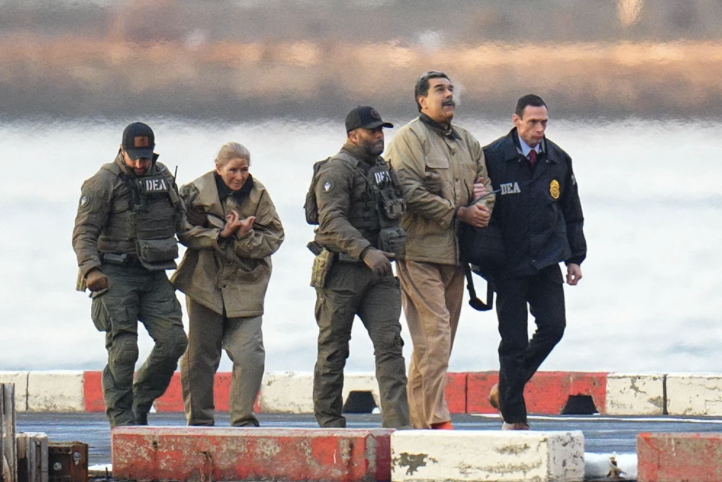
Venezuelan President Nicolás Maduro and his wife, Cilia Flores, are escorted by federal agents in Manhattan on Monday. Photo by Getty Images.
Introduction
In early January 2026, the United States military conducted an operation in Caracas, Venezuela, resulting in the capture of Venezuelan President Nicolás Maduro and his wife, who were subsequently transported to the United States to face criminal charges. The operation has sparked debate across legal, political, and diplomatic spheres about the scope of U.S. executive authority and the constraints imposed by domestic constitutional law and international legal norms. Reports indicate that the U.S. action was described as a coordinated military extraction across multiple branches of the American armed forces and law enforcement entities. These circumstances raise foundational questions about presidential war powers, congressional oversight, state sovereignty, and the international legal framework governing the use of force. This article analyzes how the U.S’s intervention tests the constitutional allocation of war powers between the president and Congress, the constraints imposed by the United Nations Charter and customary international law on the use of force, and the legal implications of prosecuting a foreign leader taken into U.S. custody following such an operation.
Presidential Authority and Domestic War Powers
The U.S. Constitution divides authority over military operations between the legislative and executive branches. Under Article I, Congress is granted the power to declare war and fund military forces, while Article II vests the president with authority as Commander-in-Chief. The Trump administration justifies the operation by referencing this authority, arguing that the mission was a limited, non-war operation that did not require congressional approval. It claims that Maduro was not a legitimate head of state, framing the capture as a law-enforcement action. Historically, presidents of both U.S political parties have invoked Article II powers to conduct similarly limited operations without prior congressional authorization. A frequently cited example is the 1989 U.S. intervention in Panama, in which President George H.W. Bush ordered the capture of Manuel Noriega, an indicted leader whose claim to head-of-state immunity was rejected by U.S. courts on the basis that he was not recognized as the legitimate leader. The War Powers Resolution complicates the Trump administration’s reliance on Article II Commander-in-Chief authority by requiring that the president introduce U.S. armed forces into hostilities only pursuant to a declaration of war, specific statutory authorization, or a national emergency, while also mandating consultation with a notification to Congress. However, these justifications expose significant legal uncertainties, as both the classification of the operation and the denial of head-of-state status remain contested under domestic and international law.
International Law and the Use of Force
Under the United Nations Charter, the use of force by one state against another is generally prohibited unless justified under narrow circumstances. Article 2(4) of the Charter prohibits force against the territorial integrity or political independence of any state, while Article 51 permits self-defense if an armed attack occurs. The capture of Nicolás Maduro satisfies neither condition; Venezuela did not attack the United States, and the operation targeted a head of state on foreign soil, directly violating the territorial integrity the Charter was designed to protect. The operation is not merely in tension with international law; it contradicts it.
Sovereignty and Regime Change
The capture of a sitting president implicates principles of sovereignty and nonintervention that are central to the post-World War II international legal order. Sovereignty is understood as the authority of each state over its territory and government, free from external interference. The transition of government authority within a state is expected to occur through internal political processes or negotiated arrangements, not through foreign military force. The circumstance in Venezuela, where the United States executed a military operation resulting in the removal and prosecution of a sitting president redefines the boundaries of sovereignty. If a sufficiently powerful state can unilaterally remove a foreign leader under the banner of law enforcement, the sovereignty ceases to function as a universal principle and becomes instead a privilege extended only to states powerful enough to defend it. The implications stretch far beyond Venezuela: if the protections guaranteed by international law can be suspended by a sufficiently powerful state, then sovereignty functions not as a universal principle but as a privilege that weaker states may no longer be able to rely on.
Due Process and Extraterritorial Jurisdiction
Following the capture, Maduro and his wife, who had already been indicted by U.S. federal prosecutors on charges including narco-terrorism and drug trafficking, were arraigned in the U.S. courts. The exercise of U.S. criminal jurisdiction over a foreign head of state brought into the U.S. by military action raises legal questions about the extraterritorial reach of domestic law, the applicability of doctrines like sovereign immunity, and the protections afforded under the U.S. Constitution to individuals facing prosecution. Issues such as access to counsel, the right to fair trial, and whether diplomatic or functional immunities apply in these circumstances remain subjects for legal analysis in both domestic and international law contexts.
International Response and Normative Implications
The international response to the capture was sharply divided, revealing competing interpretations of sovereignty and democratic legitimacy within international law. Several Latin American governments, including Brazil, Colombia, and Mexico, condemned the operation as a violation of national sovereignty and a dangerous precedent for unilateral intervention, while the United Nations similarly learned that such actions risk undermining the principles of the UN Charter and the norm of non-intervention. At the same time, a number of political leaders expressed explicit support, reflecting an alternative normative framework that prioritizes democratic restoration and accountability. Argentina's president, for example, described the capture of Nicolás Maduro as “excellent news for the free world,” while Israel's foreign minister praised the operation as a stand against authoritarian rule and in defense of democratic rights. These contrasting responses highlight a growing fracture in international norms, as states remain divided over whether the principle of non-intervention should remain absolute or yield in cases involving authoritarian governance, transnational crime, or threats to democratic order.
Public reactions further complicated this landscape, as Venezuelan diaspora communities in cities such as Miami openly celebrated the operation, highlighting how perceptions of legitimacy can diverge sharply from formal legal standards. Taken together, these competing responses reveal an emerging fracture in international norms, suggesting that contemporary interventions, particularly those justified through counterterrorism, transnational enforcement, or democratic restoration, are testing the limits of the traditional non-intervention principle and contributing to an increasingly contested legal order.
Conclusion
The U.S. military capture of Nicolás Maduro in January 2026 does not admit of resolution under any single framework. Domestic constitutional law, international legal norms, and principles of sovereignty each yield different conclusions, and the international community remains sharply divided over which framework should govern. For some, the operation represents a legitimate exercise of executive authority and a necessary response to transnational crime and authoritarian governance. For others, it constitutes a unilateral violation of sovereignty that undermines the foundational principles of the post-World War II international legal order. What this case ultimately reveals is not a definitive legal answer but a deepening tension between competing normative frameworks: a tension this operation has sharpened, and that the international community has yet to resolve.
Chloe Rotonda (CC ‘29) is a Staff Writer planning to double major in Political Science and Philosophy on the pre-law track. She is interested in American politics and international relations, particularly to questions of justice, democratic governance, and the ways legal institutions shape both domestic policy and global affairs.
Edited by Gabriella Casey Garrido