
Neglected Suffering: The Indigenous Venezuelan Struggle With Oil
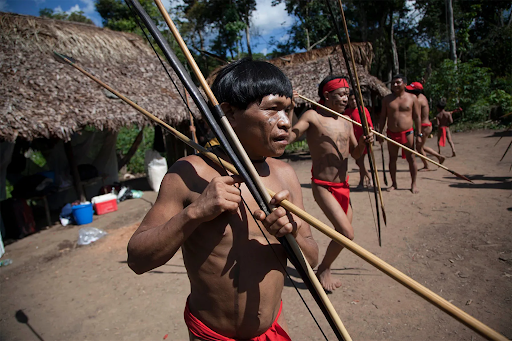
Yanomami Men of the village of Irotatheri in Venezuela Ariana Cubillos / AP/Shutterstock.com
The recent United States capture and detention of Venezuelan Nicolás Maduro, whose claim to the presidency was highly contested, has sparked much discourse about the role of oil in American politics. While many of the conversations focus on monetary gains and losses, less attention is being paid to how the extraction of oil affects the indigenous communities of Venezuela. Given President Donald Trump’s plan to take control of Venezuela's oil reserves and increase their oil production, it is crucial now to evaluate the ways in which indigenous communities are forced to bear the brunt of oil production and how that impacts their ability to operate. Specifically, the development of oil production in Venezuela violates Articles 99 and 100 of the Venezuelan Constitution by impacting Indigenous peoples’ constitutional rights to land, culture, and equal protection.
Large-scale exploitation of Venezuelan oil began back in 1922. At first, the production, infrastructure, and commercialization of oil was primarily privatized, under the control of companies from foreign countries, most notably Great Britain and the United States. As a result, the Venezuelan state merely received royalties while the majority of the profit remained with the foreign companies. In 1976, the production of oil was nationalized, institutionalizing “Petróleos de Venezuela,” also called PDVSA, to remedy this lack of national profit and reclaim ownership of Venezuelan natural resources.
At first they successfully operated independently while maintaining partnerships with foreign companies, allowing Venezuela to lead oil production and, as a result, achieve short-term financial success. The acquired profits served as the financial foundation of public spending and infrastructure investment, meaning that when the oil industry is disrupted, it reverberates heavily throughout the whole economy and way of life in Venezuela. However, as political unrest mounted under Hugo Chavez’s regime, which Maduro’s current regime is a continuation of, oil profits were less and less being used for public spending. Additionally, oil workers’ strikes and then subsequent firing of workers led to decreased oil production, which echoes throughout the rest of Venezuelan society.
This decrease in oil production became especially clear in 2014 when severe gasoline shortages began due to declining production of oil. In last ditch efforts to salvage oil production and thus end shortages and gain profits, Venezuela began to turn control of oil production back to foreign companies, which provided temporary relief but ultimately weakened domestic infrastructure. The lack of profit from oil, the shortage of gasoline, and the rippling consequences on everyday life led to much social unrest that continues to persist into the present day.
However, a group that particularly continues to have their participation challenged in oil production is the Indigenous peoples of Venezuela. The majority of the oil reserves in Venezuela are located in the Orinoco Belt, and the majority of the Venezuelan Indigenous peoples call the same Orinoco Belt home, meaning that oil reserves are frequently in or near Indigenous peoples’ land. This is significant for how it impacts both the literal land and livelihood of Indigenous peoples, as well as its consequences for their ability to practice their culture and traditions.
Firstly, a peer-reviewed study on the environmental impact of oil extraction in Venezuela showed that there is a significant degradation of ecological conditions as a result of oil extraction. Specifically, they found that serious water pollution, biodiversity loss and hydrological disruption comes at a cost of oil extraction. The most severely impacted areas were two Indigenous regions, Orinoco belt and Lake Maracaibo, meaning that Indigenous peoples experience more severe environmental instability as a result of oil extraction than do any other peoples in Venezuela. The fact that they face the worst of these consequences makes it clear how important it is to pay them special attention when considering the future impacts for oil extraction.
For example, a Colombo-Venezuelan activist Ediana Montel, a Wayúu indigenous person, predicts that increased oil extraction will only lead to severe displacement and will handicap the Indigenous peoples from practicing their cultures by either removing them from their ancestral lands, or it will degrade the land to the point that it no longer has the materials needed for traditional practices. In this way, it will both literally and socioculturally displace and degrade Indigenous peoples. Montel was able to come to this conclusion as a result of looking at how mining has already caused such horrible environmental damage and brings so much violence that 6,000 indigenous Venezuelans have fled since 2019.
Specifically, the mining of gold in the Orinoco Belt has been shown to cause numerous significant struggles for Indigenous peoples. The consequences of mining work or extraction work is that water sources are contaminated, leading to a general loss of biodiversity as well as food insecurity and increased threat of diseases. On top of this, the military presence that comes along with these activities not only disrupts traditional indigenous ways of life, but also subjects them to violence. In fact, violence against Indigenous peoples becomes very severe in situations where companies enforce mining on indigenous reserves or near them. For example, many leaders of Indigenous groups who stand up against these activities are murdered. So, it is very reasonable to expect such consequences to only worsen if the extraction of oil in Venezuela is expanded.
This is an important conclusion to acknowledge, as President Trump specifically “authorize[d] certain firms in Venezuela to expand their operations, including pursuing additional upstream oil and gas projects” on February 13th of this year. Since President Trump has already authorized this and plans to continue to rapidly implement similar efforts, it is clear that areas already facing oil extraction will only face more and areas that may not have previously been will now. This expansion will lead to the worsening of already severe ecological, violent and sociocultural distress on specifically the Indigenous peoples of Venezuela, given these same sites of oil deposits are their homes.
However, it also violates the Venezuelan constitution. Article 99 of the Constitution of the Bolivarian Republic of Venezuela declares that “The State guarantees the protection and preservation, enrichment, conservation and restoration of the cultural tangible and intangible heritage and the historic memories of the nation.” However, by allowing the tangible heritage of the specific ancestral land of Indigenous peoples, and the intangible heritage of Indigenous culture and tradition to be destroyed, as is the product of oil production, the constitutional rights of Indigenous peoples are being violated. Moreover, it too violates article 100’s promise of “respect for intercultural relations under the principle of equality of cultures,” given Indigenous peoples are specifically facing worse consequences, and in this way are not experiencing equality of cultures.
Initially, one might think that the prosperity of nationalizing oil via founding the PDVSA would safeguard the domestic rights of Indigenous peoples. However, this bureaucratic change has not translated into meaningful improvements for Indigenous communities. Instead, PDVSA failed to account for Indigenous interests, and oil extraction has continued on Indigenous lands without proper consideration, long before U.S. intervention. In this way, the nationalization of oil is still extracting the natural resources away from the Venezuelan people: exploiting the natural resources and ways of life of the Indigenous community. This paradox becomes even more concerning when considering the nation’s outcomes. Not only are Indigenous communities facing land degradation, resource loss, and threats to their livelihoods, but these harms have not resulted in broader national gain. Venezuelan oil production has declined by 75% since 1998, and living standards have declined by 74% since 2014.
The Venezuelan government not only has failed to protect the tangible heritage, namely the land and resources of the Indigenous peoples, violating article 99, but the fact that this failure has occurred without delivering meaningful economic benefit only reinforces the urgent need for structural change in Venezuela.
In order to follow through with the promise of prosperity that the nationalization of oil was meant to fulfill, the Constitution of the Bolivarian Republic of Venezuela needs to be completely respected and adhered to. This would result in an approach to oil production that does not make the Venezuelan government a mere financial beneficiary, but instead it would prioritize benefiting the quality of life of all Venezuelans. In this way, the exacerbated dangerous harms of environmental damage, violence on Indigenous peoples, and the degradation of Indigenous peoples’ ability to practice their culture–harms that President Trump’s plans of accelerated oil production would cause–can be mitigated.
Sofia Freitas (CC’29) is majoring in Philosophy. She is interested in what it means to be human and how such things are interpreted in society, such as under the guise of ethnicity.
Edited by Isabella Pazmino Schell