
The Un-American Experiment: President Trump’s Ban on Birthright Citizenship
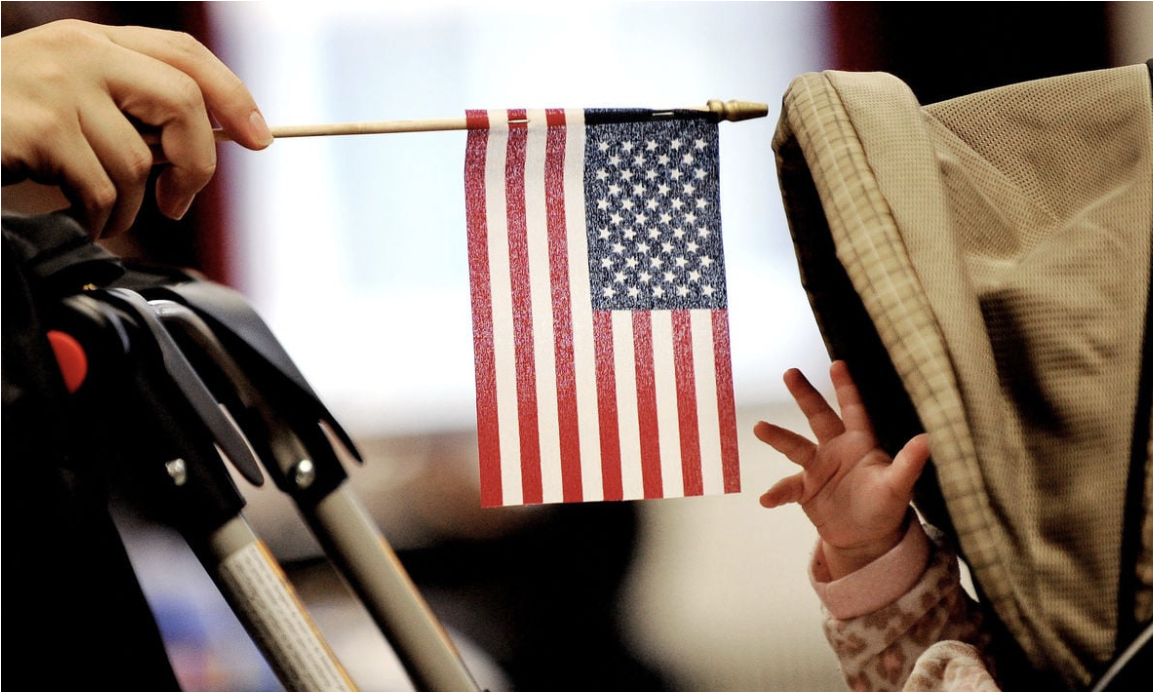
A baby in a stroller reaches for the American flag at a naturalization ceremony. Los Angeles Times, Justin Lane, European Pressphoto Agency (EPA).
When President Trump was inaugurated in January of 2025, he assumed office with an ambitious agenda, signing twenty-six different executive orders on his first day. Notable directives included creating a brand-new government agency in order to combat bureaucratic inefficiency and renaming the body of water that borders more of Mexico than it does the United States the “Gulf of America.” But somewhere along the way, President Trump managed to sign directives that extend far beyond rhetorical policy disputes, calling into question our credence in the Constitution itself as the law of the land.
Executive Order 14160 seeks to ban birthright citizenship, declaring that “United States citizenship is a priceless and profound gift,” one that cannot be lackadaisically conferred to just anyone by simple virtue of being born on American soil. With the Supreme Court set to hear oral arguments on the constitutionality of the order next month, this assault on birthright citizenship must be understood as an assault on the American Experiment itself.
Birthright citizenship dates back to the English common law principle of jus solis, or “right of soil,” simply meaning that the land on which a person is born is determinative of their citizenship. It was in this way that the British empire was able to claim generations of colonists in externally controlled territories as subjects of the crown. When the American revolutionaries declared independence and founded this country, fealty to the principle of birthright citizenship remained and was eventually inscribed by amendment into the language of the Constitution.
In Lynch v. Clarke, an 1844 case in the state of New York, jus solis was used as the primary reasoning to affirm Julia Lynch’s status as a U.S. citizen, despite the fact that she was born to Irish-national parents who were on a temporary travel visa at the time of her birth. Judge Lewis Sandford wrote in the opinion, “I can entertain no doubt, but that by law of the United States, every person born within the dominions and allegiance of the United States, whatever were the situation of his parents, is a natural born citizen.” Though not yet explicit in the law, birthright citizenship was commonly understood and applied by legal scholars as an immutable principle.
Unfortunately, this lower court precedent was not binding on the federal government. Without the overt inclusion of jus solis in the original Constitution to cement its inviolability, the Supreme Court was able to deny freed slaves—who were born on the same soil they’d been forced to work—the full rights and liberties of citizenship. In the now infamous case of Dred Scott v. Sandford (1857), the court held that anyone ancestrally tied to those imported into the United States and sold as slaves—whether free or enslaved themselves—were not American citizens. Widely reviled and considered to carry the “deepest stigma” of any Supreme Court case, the precedent set by the Taney Court called for a rectification of equal strength: constitutional amendment.
After the Civil War, the ratification of the 14th Amendment codified citizenship as an inherent right of those born in this country, correcting the abuses of Dred Scott. The 14th Amendment provides: “All persons born or naturalized in the United States, and subject to the jurisdiction thereof, are citizens of the United States and of the State wherein they reside.” Simply put, those born here belong here, regardless of their parents’ citizenship status.
United States v. Wong Kim Ark (1898) affirmed this right, clarifying that “subject to the jurisdiction of” plainly means those to whom American laws apply. This effectively excludes a small cohort of children whose parents are either diplomats representing another nation, foreign enemies in hostile occupation, or Native Americans subject to tribal laws. However, contrary to what the Trump Administration argues, the amendment’s language does not provide that the personal political allegiances of those under US law have any bearing on the privilege of citizenship.
Yet despite nearly 160 years of precedent in favor of birthright citizenship, President Trump would restrict that right on the basis of parentage. Under the order, children must be born to at least one naturalized or green card-holding parent in order to deserve American citizenship. The Migration Policy Institute estimates that were this unconstitutional restriction to take effect, it would effectively delegitimize 225,000 newborns a year. That’s 2.7 million non-citizen children by 2045.
The undeniable force of that figure is precisely why judicial approval of the order is paramount for the Trump Administration. As Columbia Professor of History and Asian American Studies Mae M. Ngai argues, systematically denying birthright citizenship “addresses the long-held Republican obsession to erect a bulwark against the growing numbers of Latino and Asian Americans who are eligible to vote.”
While this may just be an electoral strategy, the implications of a lack of citizenship for the unborn children of immigrants this order threatens are reprehensibly reminiscent of the age of Jim Crow and its subversive systems of social and legal exclusion. The denial of citizenship is synonymous with the denial of the health, safety, security, and dignity that accompanies recognized legal status. Millions of children—unable to obtain a driver’s license or passport, access to higher education, health insurance, or employment—would be relegated to a “self-perpetuating, multigenerational underclass,” contradicting the uniquely American conception of individualism and equal opportunity. Immigrants would not be the only ones affected, as the Brennan Center recognizes that “Under the new legal regime the order would create, everyone would be vulnerable to having their citizenship questioned.”
Not only is President Trump’s mission to “Protect the Value and Meaning of American Citizenship” unconstitutional, it’s also illogical considering the context of our founding. It was because so many Europeans in the 17th and 18th centuries migrated to the Americas in pursuit of a better life that their descendants could dare to consciously depart from the status quo of empires and conceive the experimental notion of institutionalized freedom and equality for all. As articulated by Former U.S. Secretary of Commerce Carlos Gutierrez, “Today’s immigrants, just like our forefathers, arrive here seeking the ability to freely worship, to express themselves without fear of government retribution, and to chart their own economic destiny.” The fact is, this great American Experiment wouldn’t exist were it not for immigration, and it will be immigrants—as well as their children—who are responsible for seeing it through.
The children of immigrants are the driving force behind our country’s sociopolitical and economic advancement, both domestically and abroad. Kamala Harris, Marco Rubio, Nikki Haley, Vivek Ramaswamy—all household names and presidential hopefuls in 2024, all proudly identified as second-generation immigrants. Across the political spectrum, the leaders of our democratic project have gained access to their platforms of change by virtue of their citizenship under the 14th Amendment’s birthright clause. Our economy tells the same success story, as nearly half of all Fortune 500 companies were founded by immigrants or their children, responsible for employing over 15.4 million people and generating $8.6 trillion in revenue in 2024 alone.
On the global stage, of the 230 Olympic athletes who represented the United States in Milano’s 2026 Winter Olympics, 31 were the children of immigrants. The International Olympic Committee requires athletes to be citizens of the countries they represent. Under Trump’s order, those 31 athletes—including Alysa Liu, the American-born daughter of a Chinese political refugee who clinched the first gold medal in figure skating for the United States since 2006—would not have been able to compete for America. The impact of immigrants on our nation is as impressive as it is irrefutable.
Birthright citizenship is an avenue that has granted millions—including myself—the privilege to participate in this grand civic project. It’s a right that has been tacitly understood, meticulously dissected, and explicitly secured over the course of centuries, and it cannot be written away with the stroke of an executive’s pen. As we anticipate the Supreme Court’s decision on the constitutionality of President Trump’s order, it’s not just immigrants’ children whose fate remains unresolved, but that of an entire nation whose consciousness has long been predicated on adherence to the Constitution of the United States, if nothing else.
Rebeca (CC '27) is a Staff Writer majoring in Political Science and Human Rights. She is interested in issues of governance and public interest, and is currently in the process of applying to graduate school to pursue a J.D./M.P.P.
Edited by Sylvia J. Martinez-Lopez.