
Child First, Immigrant Second: Extending Juvenile Criminal Protections to Civil Immigration Detention
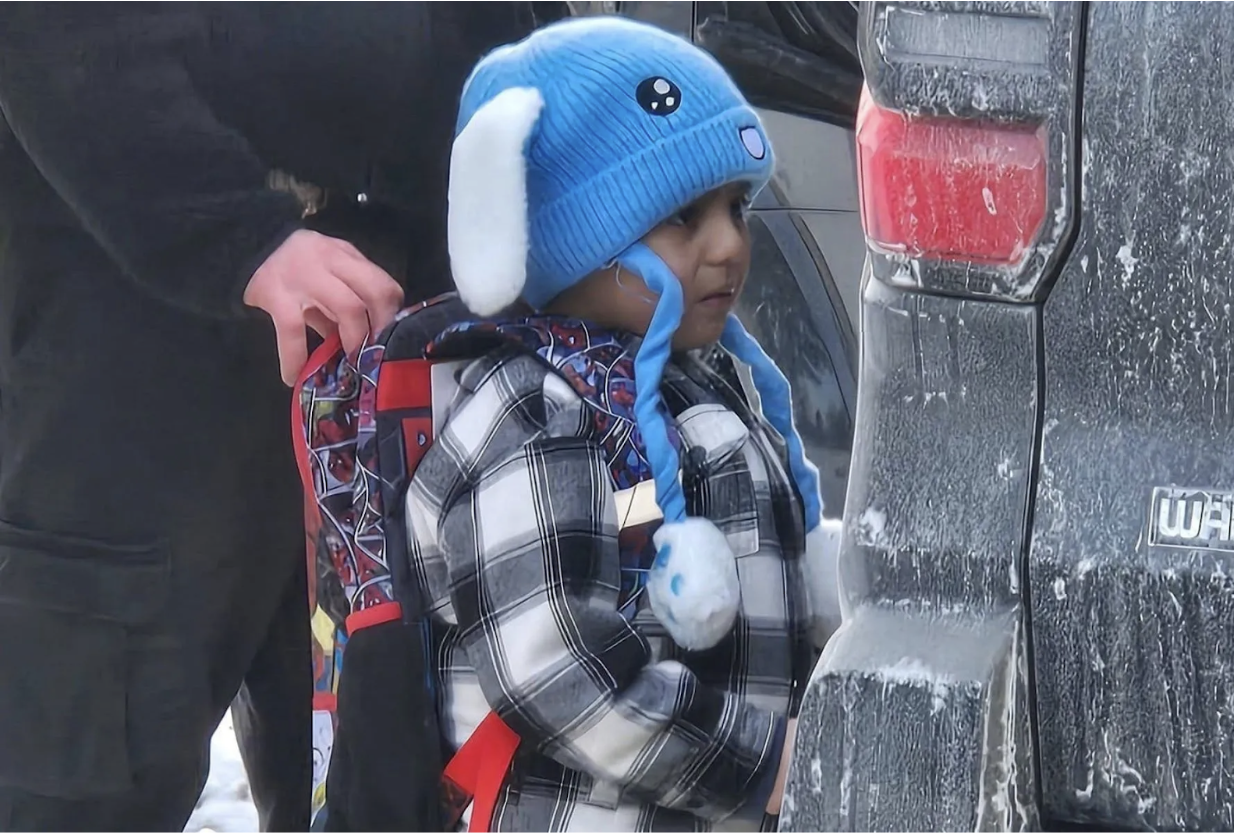
Liam Conejo Ramos detained by Immigration Customs Enforcement officers on Tuesday, January 20th, 2026. Photo provided by Columbia Heights school officials Credit: Ali Daniels
On a Tuesday afternoon the school bell rings as 5-year-old Liam Conejo Ramos is released from preschool. His father picks him up for their typical walk home in the Minnesota winter when life, as he knows it, is flipped on its head. His father is detained by Immigration and Customs Enforcement (ICE) officers, and Liam, with him, was transported over 1,300 miles from Minnesota, to a detention center in Dilley, Texas. Liam's story hits the headlines, and the question on everyone's minds is: How could the law allow ICE to detain a 5-year-old?
The Supreme Court has recognized that children are categorically different from adults. Considering a child’s heightened vulnerability and diminished capacity for knowledge of wrongdoing, the Constitution has restricted the imposition of the harshest penalties for children under the Eighth and Fourteenth Amendments. These include the death penalty, mandatory life without parole, and life without parole for non-homicide offenses. Yet, in the context of immigration enforcement and civil detention, a child’s citizenship status has taken precedence over their legal status as a minor. Rather than being recognized as a child first, innocent in their ignorance of the ‘crime’ they have committed, immigrant children are seen as immigrants first. They are seen as “illegal aliens” who broke the law when they crossed the border. For instance, earlier this year, ICE claimed that they detained both Liam and his father, Adrian Conejo Arias, as a means of keeping them together, despite them both having an active claim for asylum in the United States. The constitutional framework that treats children as categorically different from adults in the criminal justice system must also extend to civil immigration detention policies. In particular, these policies should account for children’s age, their heightened vulnerability to psychological harm, and their diminished capacity for knowledge of their wrongdoing or their intent to cross the border illegally.
The Eighth Amendment provides that “cruel and unusual punishments [shall not be] inflicted.” It is through the Fourteenth Amendment that this protection applies to “any person” in which they shall not be deprived of “life, liberty, or property, without due process of law” nor should they deny “any person within its jurisdiction the equal protection of the laws.” Throughout history, the Supreme Court has interpreted these Amendments in cases of juvenile punishments and has since decided the categorical limitations for extreme punishments of juveniles. For example, in Roper v. Simmons, the Supreme Court held that the Eighth and Fourteenth Amendments forbid imposition of the death penalty on offenders who were under the age of 18 when their crimes were committed. In the case of Roper v. Simmons, this decision was held on the basis that juveniles have an “underdeveloped sense of responsibility.” Therefore, they are more susceptible to recklessness, impulsivity, and heedless risk-taking. Five years later, in Graham v. Florida, the Supreme Court furthered this reasoning as an extension of Roper v. Simmons. The Court held that, under the Eighth and Fourteenth Amendments, the Constitution does not permit a juvenile offender to be sentenced to “life in prison without parole for a nonhomicide crime” because “when compared to an adult murderer, a juvenile offender who did not kill or intend to kill has a twice diminished moral culpability.” This reasoning is to say, because of “juveniles’ impulsiveness” and “difficulty thinking in terms of long-term benefits” children by nature are less able to navigate long-term cost-benefit analysis. It was determined that life without parole denies children the opportunity to change and demonstrate reform, despite being more capable of change. As such, it was held that irrevocable punishment is constitutionally disproportionate in the case of children.
Thus, it is clear that juvenile criminal defendants receive constitutional protections and have this under their categorical difference of an “underdeveloped sense of responsibility,” “ difficulty thinking in terms of long-term benefits,” and “twice diminished moral culpability.” However, the Bill of Rights, and the protections it holds for juvenile offenders based on these categorical differences are not extended to immigrant children. Yet, immigrant children are still children and, as such, remain subject to the same categorical differences that are taken into consideration when sentencing a child with U.S. citizenship. Time and time again, the Supreme Court has recognized that the age of a defendant is relevant and has since exempted children for some of the most major crimes. How then are these same protections not applicable to children whose ‘crime’ is that of entering the country illegally?
Aside from not being citizens, immigrant children are deprived of the right to life, liberty, and due process because deportation proceedings are considered civil. Despite this distinction, children like Liam are being considered and treated as if they have committed a criminal offense rather than a civil one, but lack the same protections as any other person that has committed a crime within the United States. Because the detention of immigrants is not considered ‘punishment for a crime’, they do not receive the same procedural protections. For instance, in the case of Fong Yue Ting v. United States, the Supreme Court determined that “the government, possessing the powers which are to be exercised for protection and security” has the “authority to determine the occasion on which the powers shall be called forth; and its determination, so far as the subjects affected are concerned, is necessarily conclusive upon all its departments and officers.” The government and all its departments and officers have the power and authority to expel non-citizens if they so shall choose to, regardless of the actions of the non-citizens. Through this case, the Supreme Court held that “banishment” is evidently used in the sense of expulsion or deportation by the political authority on the ground of expediency, and not in the sense of transportation or exile by way of punishment for crime. Therefore, because deportation is not considered a ‘punishment’ (despite causing significant emotional, and at times physical, turmoil in response to the ‘wrongdoing’ of crossing the border illegally), then many criminal procedural protections do not apply.
Moreover, in the case of INS v. Lopez Mendoza, the Court further reinforced the civil classification of immigration detention by holding that the exclusionary rule (the prohibition of illegally obtained evidence) does not apply in deportation proceedings. Even if an unlawful arrest occurred, the identity of the immigrant detained is not suppressible. Thus, because deportation proceedings are considered ‘civil’, the practical implication in immigration law often functions as guilty until proven innocent. The responsibility of the government lies only in establishing deportability through “clear, unequivocal and convincing evidence”, not proof beyond a reasonable doubt, which is the case for criminal proceedings. Immigrants can be detained unlawfully without prior criminal convictions, and the burden shifts to the respondent to prove a lawful presence. This burden of proof is especially concerning for children (particularly those without counsel) because they may lack the capacity to understand not just the ‘crime’ that they have committed but the legal system. This is exemplified in the video, “UNACCOMPANIED: Alone in America” when Judge Snouffer asks child immigrant Sophia, “Do you know what a lawyer is?” Sophia answers him with a clear “no”. When asked if she has one, her undeniable lack of knowledge of the law is highlighted in her response “No se,” (I don’t know) she says in Spanish. Not only does Sophia have no understanding of the law, she doesn't even speak the language being used in court.
In criminal proceedings, competency of the defendant is constitutionally required. Under Dusky v. United States, the Supreme Court has recognized that a defendant must possess a rational and factual understanding of the proceedings and the ability to consult with counsel. While this case is speaking directly on the incapacity of those with intellectual disabilities, a similar argument can be made for children because they lack that same mental capacity to recognize an understanding of the proceedings they are being held to. This same requirement is not expected of immigrant children in legal proceedings, but when taking into consideration the age of a child, does it seem that children like Sophia truly possess the understanding necessary to be tried for this ‘crime’? Children detained with their parents, just as Liam Conejo Ramos was, can be separated, held in detention without the same constitutional safeguards as a person held for a crime, and are expected to challenge evidence or procedure in the same way an adult would.
Considering the alarming increase of ICE detentions and deportations in the past year (arrests have quadrupled, street arrests have increased over elevenfold, arrests of people without criminal convictions have increased sevenfold, and deportations within two months rose from 55% to 66%), the risk of detention for children is more than just a hypothetical. In rapid deportation actions, children have been, and can be, detained with their parents or guardians and find themselves alone–without a guardian, representation, or a way to prove their innocence and identity. The absence of safeguards in place to protect the rights of immigrant children is just as unreasonable as it is to hold minors as accountable as adults in the death penalty, mandatory life without parole, and life without parole for non-homicide offenses.
Just as the Constitution takes into consideration a defendant's age in relation to the punishment for their crime committed, it should take into consideration an immigrant's age in relation to their detention and deportation. Juvenile criminals are considered categorically different from adults in the court of law and must be sentenced under different circumstances because of their underdeveloped sense of responsibility, impulsivity, and immaturity. Immigrant children must be recognized in that same regard. Especially young children like Liam Conejo Ramos, because of their diminished capacity for knowledge of wrong and intent to cross the border illegally. As such immigrant children should be treated categorically different from adults when facing immigration detention policies. They remain children first and deserve protection, not punishment.
Noemi (CC’29) is a Staff Writer majoring in Political Science with a minor in Human Rights. She is interested in social justice and immigrant rights.
Edited by Patricia Bessie