
Legality or Decriminalization?: A Qualitative Legal Analysis of Differing Sex Work Regulation Models
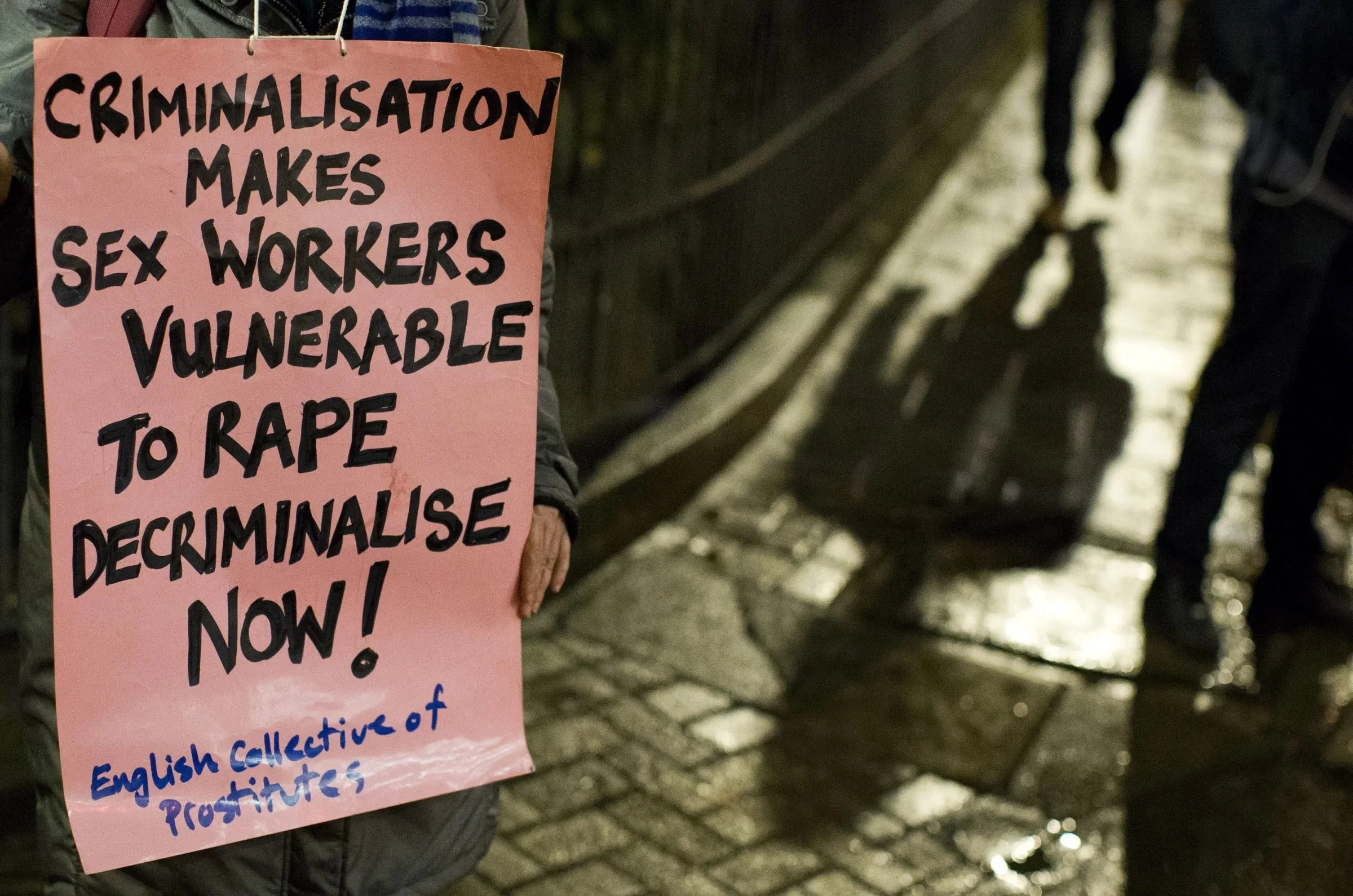
A person holding a pink protest sign. The sign reads: “Criminalisation makes sex workers vulnerable to rape — decriminalise now!” At the bottom, it is signed by the “English Collective of Prostitutes. The message suggests that when sex work is criminalized, people in that industry are pushed into unsafe conditions. Photo by Justin Tallis/AFP via Getty Images.
Abstract
Although prostitution is not criminalized in the Dominican Republic, the surrounding legal framework produces conditions of structural vulnerability. This article asks: Does the Dominican Republic’s partial criminalization model (criminalizing proxenetismo but not prostitution) function more like legalization or de facto criminalization in practice? Drawing on doctrinal analysis, jurisprudence, and advocacy reports, this piece argues that the current regime operates as a form of indirect criminalization, exposing sex workers to state violence and legal insecurity. Through comparative analysis with New Zealand (decriminalization), Germany, and the Netherlands (legalization), this article contends that full decriminalization offers a more coherent and rights-protective framework within the Dominican legal context.
Introduction
“El proxenetismo es penado, la prostitución no” (“Pimping is penalized, prostitution isn’t”). Proxenetismo is broadly defined as third-party facilitation or exploitation of prostitution. The phrase has become shorthand for understanding sex work law in the Dominican Republic, circulating across media, legal commentary, and public discourse. On its face, it suggests a balanced legal regime: one that tolerates individual autonomy while targeting exploitation. But this framing is misleading. It reduces a complex legal structure into a binary that does not hold in practice.
The Dominican system is neither neutral nor protective. Instead, it produces a condition of legal liminality, meaning a state where sex work is formally permitted but structurally constrained. This contradiction raises a central research question: To what extent does the Dominican Republic’s Penal Code, and its articles on sex work, produce protection versus vulnerability, and which regulatory model, whether legalization or decriminalization, better addresses this tension? This article argues that the current system operates as a form of de facto criminalization, and that decriminalization, instead of, legalization offers the most viable path toward aligning Dominican law with principles of dignity, equality, and legal coherence. Decriminalization means that sex work is legal without any special parameters and that, therefore, sex workers have the same amount of labor rights, and workers rights, as anyone working in any other industry.
Literature Review
The regulation of sex work globally is typically understood through three dominant frameworks: criminalization, legalization, and decriminalization. Legal scholars and international organizations have long debated these models. The Amnesty International Policy on Sex Work advocates for decriminalization as a human rights imperative, arguing that criminal laws increase vulnerability to violence. Similarly, the UNAIDS Guidance Note emphasizes that punitive frameworks undermine public health and access to services.
By contrast, legalization models–such as those in Germany and the Netherlands–have been analyzed as attempts to integrate sex work into formal economies. The Dutch government has regulated prostitution through licensing and zoning, while Germany has expanded labor protections under the Prostitutes Protection Act. However, scholars have critiqued these systems for excluding marginalized workers, particularly migrants.
New Zealand’s Prostitution Reform Act of 2003 is widely regarded as the leading decriminalization model. Government reviews have found that decriminalization improved worker safety and access to justice without increasing the size of the industry. And yet, in Latin America, scholarship and advocacy reports–such as those by RedTraSex–highlight how partial criminalization creates conditions for police abuse and legal ambiguity. These findings are particularly relevant to the Dominican Republic, where legal doctrine and enforcement diverge sharply. Despite this body of work, there remains a gap: few analyses center the Dominican legal framework as a distinct case of “legal but unprotected” sex work. For this reason, this research addresses that gap.
Method
This study employs a qualitative legal analysis, combining doctrinal analysis of Dominican penal law, case law interpretation, comparative legal analysis, and close reading of advocacy and institutional reports. In addition, it incorporates the interpretive analysis of first-hand experiential accounts produced by sex workers in digital spaces, treated as qualitative evidence of how legal frameworks are understood and navigated in practice.
Primary legal sources include the Dominican Código Penal, Supreme Court jurisprudence, including the Pasión Night Club case, and relevant international legal frameworks and policy documents. Secondary sources include reports from OTRASEX/REDTRASEX, international organizations, and socio-legal scholarship. These are supplemented by publicly available first-person narratives, including digital testimonies, which provide insight into the lived effects of regulatory regimes across different legal contexts.
The unit of analysis is the legal treatment of sex work as structured through doctrine and enforcement, with particular attention to how law operates in practice. By situating formal legal analysis alongside experiential accounts, the study bridges the gap between legal frameworks “on the books” and their manifestation in everyday life.
Results
1. The Dominican Legal Framework Produces Indirect Criminalization
Dominican law does not criminalize prostitution itself. The Código Penal (Penal Code)–the body of legal rules that defines offenses, crimes, and infractions establishing the penalties imposed by the State–defines but does not prohibit it. However, it criminalizesproxenetismo–primarily through Article 334–covering a wide range of third-party involvement. It also prohibits many conditions necessary for safe work, including collective organization and third-party protection. The result is a system where legality exists in theory, but not in practice.
A closer reading of the Dominican Código Penalreveals that the apparent neutrality of the legal framework is largely illusory. While prostitution itself is not explicitly criminalized, Article 334 defines and penalizes proxenetismo in broad terms, encompassing not only exploitative conduct but also a wide range of third-party involvement. This includes facilitating, benefiting from, or organizing prostitution in ways that are not clearly distinguished between coercive and consensual contexts.
The breadth of this provision creates significant interpretive ambiguity. In practice, activities that are essential for safer working conditions–such as working collectively, hiring security, or operating within organized establishments–may fall within the scope of prohibited conduct. As a result, sex workers are effectively prevented from accessing forms of protection that would otherwise reduce exposure to violence and exploitation.
This dynamic reflects a form of regulatory overreach driven by legal indeterminacy, where laws are formally limited in scope but drafted in sufficiently broad terms to enable expansive enforcement. The lack of clear statutory distinctions between exploitation and facilitation allows authorities to interpret proxenetismo in ways that blur the line between protection and punishment. Moreover, the Código Penal does not provide a coherent alternative regulatory framework for sex work. Unlike legalization models that establish licensing systems or labor protections, the Dominican system leaves sex work in a legal vacuum. This absence of formal recognition means that sex workers operate without enforceable labor rights, contractual protections, or access to institutional safeguards.
2. Jurisprudence Reinforces Legal Ambiguity
In the Pasión Night Club case, through Sentencia núm. 001-022-2021-SSEN-00872, the Supreme Court of Justice of the Dominican Republic affirmed acquittals due to insufficient evidence of proxenetismo. The Court emphasized the need for identifiable victims and clear proof of exploitation. This high evidentiary threshold limits prosecutions–but also reveals the instability of the law. If facilitation cannot be easily proven, enforcement becomes selective rather than consistent.
Beyond the Pasión Night Club case, Dominican jurisprudence provides further insight into how the legal framework is interpreted and applied. A second line of jurisprudence on due process and illegal detention–particularly constitutional rulings enforcing protections against arbitrary arrest and police overreach–further underscores this issue. Dominican courts have repeatedly recognized limits on arbitrary arrest, yet reports indicate these protections are not applied in practice. This high evidentiary threshold reflects an effort to prevent over-criminalization; however, it also produces uneven enforcement outcomes.
In cases where exploitation cannot be definitively proven, prosecutions tend to fail, reinforcing the formal limits of the law. Yet, this judicial restraint does not necessarily translate into protection in practice. Instead, it contributes to a system in which enforcement operates selectively, often outside the bounds of formal adjudication. Police practices, rather than judicial decisions, become the primary mechanism through which the law is experienced by sex workers.
However, the gap between jurisprudence and enforcement remains significant. Empirical reports from RedTraSex document widespread police abuse, including extortion and sexual coercion. These findings suggest that the legal framework does not merely fail to protect–it actively enables abuse by granting discretionary enforcement power.
Taken together, these two lines of jurisprudence, one limiting the scope of proxenetismo, and the other reinforcing protections against arbitrary detention, highlight a fundamental contradiction. While the courts articulate a framework that constrains state power, the lived reality of enforcement reflects a system in which discretion often overrides legal safeguards. This disconnect reinforces the argument that the Dominican legal regime functions as a form of indirect criminalization, not through explicit prohibition, but through the inconsistent and discretionary application of the law.
3. Legalization Models Produce Mixed Outcomes: First-Hand Accounts
Comparative analysis shows that legalization can both increase protections and exclude vulnerable populations. In Germany, the legalization of sex work through the 2002 Prostitution Act and its subsequent regulation under the 2017 Prostitutes Protection Act (ProstSchG) formally recognized sex work as labor and introduced mechanisms such as access to social security and regulated working conditions. However, these reforms have also been criticized for introducing significant bureaucratic barriers that limit access to legal protections in practice. The 2017 law requires sex workers to register with authorities, obtain a certificate, and comply with periodic health counseling requirements, while brothel operators must obtain licenses and meet regulatory standards. While intended to enhance safety and oversight, critics argue that these requirements create deterrents to registration, particularly for marginalized workers. For instance, the mandatory registration system–sometimes referred to as a “whore ID”--has been criticized for increasing stigma, surveillance, and fears about data privacy and disclosure.
This dynamic is reflected not only in policy analysis but also in lived experience accounts. In a widely circulated social media video, creator Lucy Huxley describes, from first-hand account, how regulatory requirements and stigma shape working conditions in legalized systems, highlighting gaps between formal legality and practical accessibility. She says: “In Germany, to work legally, you have to register as a sex worker with the government, and attend mandatory health counseling sessions.” Lucy also explains that “this creates a two tiered system of workers who can afford to–or are in the position to– work legally, and lower to them, are those who aren’t.” She goes on to say: “Here in Germany, if you’re doing sex work while pregnant, you’re doing it illegally. In Greece, if you’re doing sex work while you’re married, you’re doing it illegally. In Nevada, U.S.A, if you can’t work in a brothel because one won't hire you, that means you can only work illegally.”
Moreover, empirical and legal analyses suggest that the regulatory framework disproportionately excludes undocumented migrants and other vulnerable groups, who are often unable or unwilling to comply with registration requirements. Lucy says: “In this case, the most underprivileged women, the women who need the money the most, who lack other types of support, and are unable to work legally, are forced to work illegally and are offered no protection under the law."
As a result, many continue to operate outside the legal system, where they remain exposed to greater risks of violence, exploitation, and lack of legal recourse. Lucy tells us: “In some cases, they [the sex workers] can be outright punished by the law and arrested and imprisoned for not working within set parameters.” Even broader policy critiques argue that, despite formal legalization, Germany has struggled to establish meaningful labor protections, with some scholars concluding that the regulatory approach has, in certain respects, increased rather than reduced vulnerability among sex workers.
On the other hand, New Zealand’s model demonstrates that decriminalization can enhance worker safety and strengthen access to justice. Government reviews of the Prostitution Reform Act 2003 found that sex workers were better able to refuse clients, report violence, and access legal protections without fear of criminalization.These findings are particularly significant because they reflect not only formal legal change, but a shift in how the law is experienced in practice. By removing criminal penalties, the framework reduces barriers to engaging with state institutions, allowing sex workers to seek protection without risking arrest or sanction. It also facilitates greater accountability for violence and exploitation, as interactions with law enforcement are no longer structured by fear or avoidance. Unlike legalization regimes, which often condition protection on compliance with regulatory requirements, New Zealand’s model minimizes administrative barriers, thereby expanding practical access to legal remedies. As a result, the gap between formal legality and lived experience is significantly reduced, offering a more coherent alignment between legal status and enforceable rights.
Discussion
The findings reveal a central paradox: the Dominican Republic has already partially decriminalized sex work, yet continues to produce outcomes associated with criminalization. Comparative analysis helps clarify why. When placed alongside legalization models such as Germany and the Netherlands, and decriminalization in New Zealand, the Dominican framework emerges not as an intermediate model, but as one that combines the constraints of both systems without their corresponding protections.
In Germany and the Netherlands, legalization has introduced formal recognition and regulatory oversight, including labor protections, licensing systems, and access to certain social services. These mechanisms can enhance worker safety under specific conditions. However, as the comparative findings demonstrate, legalization also produces exclusionary effects. Bureaucratic requirements, such as registration, licensing, and documentation, can limit access to legal protections, particularly for marginalized groups such as undocumented migrants. As a result, a dual system often emerges: one formal and regulated, and another informal and more vulnerable.
The Dominican Republic reproduces some of these exclusionary dynamics, but without the institutional infrastructure that characterizes legalization regimes. Unlike Germany or the Netherlands, it does not offer a formal regulatory framework through which sex workers can access labor rights or legal recognition. Instead, by criminalizing proxenetismo broadly while leaving prostitution formally legal, the law restricts the conditions necessary for safe work–such as collective organization or third-party support–without providing alternative protections. In this sense, the Dominican model reflects the burdens of regulation without its benefits.
By contrast, New Zealand’s decriminalization model provides a more coherent point of comparison. Rather than imposing extensive regulatory barriers, it removes criminal penalties and integrates sex work into existing legal frameworks, including labor and health law. The comparative evidence suggests that this approach reduces the gap between formal legality and practical accessibility, enabling sex workers to exercise rights, report abuse, and operate within clearer legal boundaries.
These comparisons highlight a key analytical distinction: the issue is not simply whether sex work is legal, but how legality is structured and operationalized. Legalization models may improve conditions for some while excluding others, whereas partial criminalization, such as that observed in the Dominican Republic, produces widespread legal ambiguity and discretionary enforcement. Decriminalization, in contrast, appears to minimize these contradictions by aligning legal status with enforceable rights. In this light, the Dominican case is best understood not as a hybrid or transitional system, but as a form of indirect criminalization that lacks the regulatory clarity of legalization and the rights-based coherence of decriminalization. Addressing this gap requires not merely reforming individual provisions, but rethinking the underlying legal approach to sex work. Decriminalization, for all sex work, offers a more consistent framework: one that reduces opportunities for abuse while maintaining the state’s capacity to regulate through non-punitive means such as labor law, public health policy, and anti-trafficking measures.
Conclusion
The claim that “prostitution is not illegal” in the Dominican Republic is, at best, incomplete. While formally accurate, it obscures a legal structure that produces vulnerability through ambiguity and discretionary enforcement. This article has argued that the current framework operates as a form of indirect criminalization, not by prohibiting sex work outright, but by restricting the conditions under which it can be practiced safely. Comparative analysis underscores that legality alone is insufficient; what matters is how legal frameworks translate into lived protections. In this respect, the Dominican model falls short. The issue, ultimately, is not whether sex work is permitted in theory, but whether the law, as structured and applied, is capable of protecting those it governs. At present, it is not.
Mariley Melo (BC ’26) is the outgoing Editorial Director of HPLR. She is graduating with two B.A.s in Political Science and History. She is interested in the intersection of human rights frameworks and local legal doctrine pertaining to sex work and human trafficking, particularly in the United States and Latin America.