
Letter from the Editor: We the Hispanics of Columbia University in the City of New York
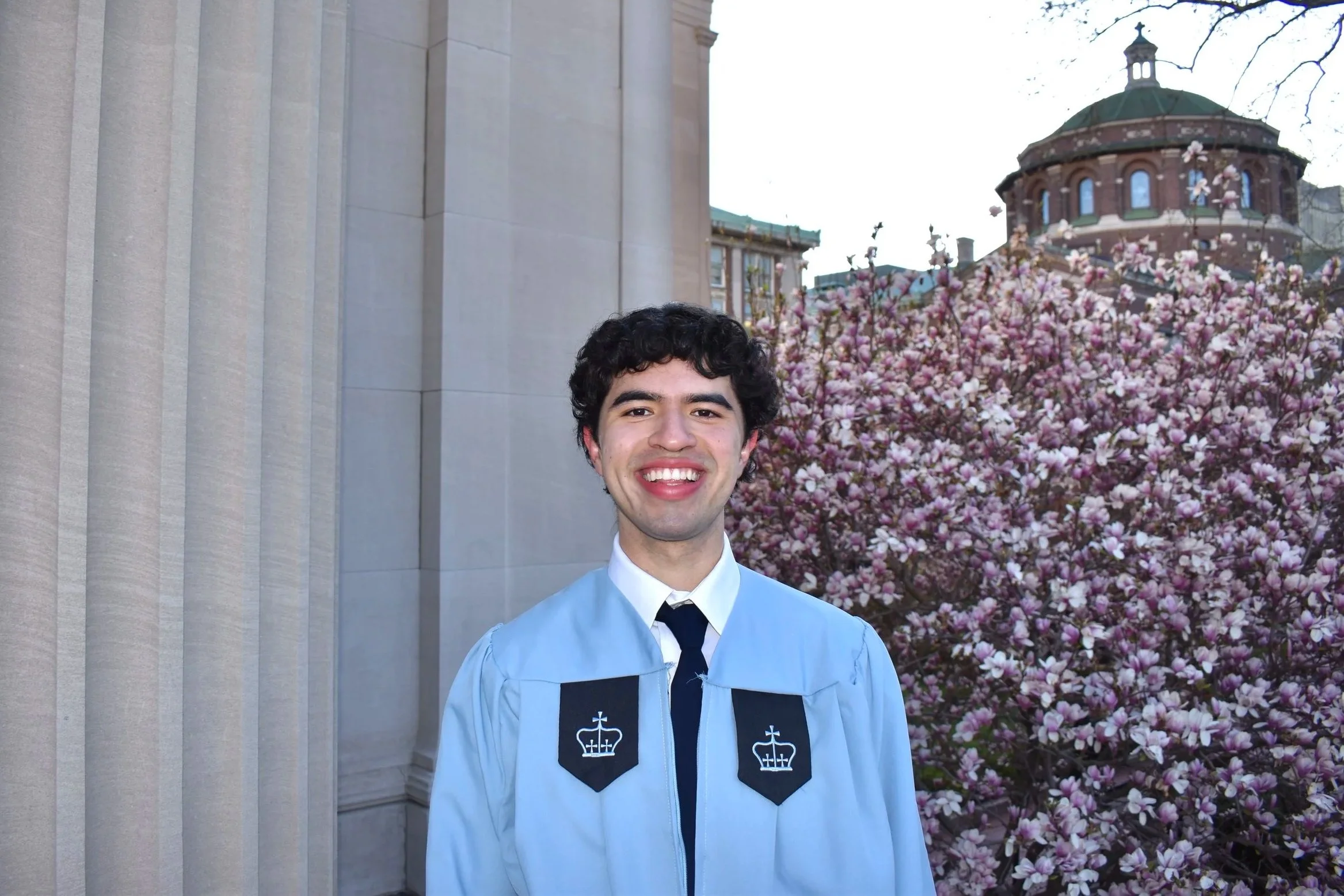
Photo taken by Wilson Zhen & Co., courtesy of the Hispanic Pre-Law Review Executive Team.
Dear HPLR Staff,
Once upon a time there was a mother. Old and wise. In the story I know, her child is a naturalized citizen. She is not. So the child knows of fear, of those who search for the mother in the name of the law.
One day the child told her: “Mamá, when I hug you, I fear no one.”
And it is because of stories like these that the Hispanic Pre-Law Review (HPLR) exists: to expand the Hispanic byline through legal analysis.
Logos is the Greek word for “discourse,” “argument.” For Aristotle, logos was defined by the argument itself and it was different from the source of persuasion that comes with the speaker. Similarly at HPLR, it is the crafting of legal arguments and the development of their stakes that defined my tenure.
At HPLR, strong legal logos is formed by four elements: a thesis, a clear legal unit of analysis, premises, and a firm conclusion. Perhaps the most important feature, in my view, is the argument of a piece for two reasons. First, the argument should make sense of the premises; second, it should develop stakes in relation to the topic. And it is through those stakes that we as Hispanic students contribute to the understanding of the law from different dimensions.
This development of stakes can be seen in the writing of our staff. For Isabella, immigration law is not just about constitutional doctrine, but about how that doctrine is operationalized through algorithms and artificial intelligence in immigration enforcement. For Rebeca, a ban on birthright citizenship does not only endanger the future of immigrant children, but also seeks to redefine the legal traditions and history upon which the United States was founded. For Sophia Sarkies, patent law research suggests that protections for innovation are not monolithic; they are shaped by the conditions that make innovation possible in the first place. And for Brigette, legal reforms are not always beneficial: redefining what constitutes “harm” in a Mexican legal remedy known as amparo places journalists and activists at risk. As she puts it, if the government and the law do not protect us all, what can a citizen do?
Like Isabella, Rebeca, Sophia, Brigette, our writers are proactive contributors to the legal discourse -- and as Editor-in-Chief, HPLR’s logos is what excited me the most.
Logos is one out of two elements that define HPLR. The second is the writer’s byline. According to one estimate, only about 5% of U.S. lawyers are Latino. That reality makes the work of this publication more urgent. Amplifying Hispanic perspectives, and the authors who write them, is important for training the future generation of lawyers, Supreme Court clerks, law firm partners, diplomats, and whatever the human imagination may lead us to. It is this collection of bylines, tied to the topics and interests that we all resonate with--to some capacity--that makes The Review both a rigorous publication in producing legal analyses and a community-building project that motivates us to contribute to increasing the 5% of Latinos in the legal profession, un día a la vez.
It is this pursuit of logos that also helps us define what HPLR is not. HPLR is a publication in partnership with the Hispanic Pre-Law Society. We are not a ragebait blog, a reporting outlet, a news organization. We do legal analysis. We first develop arguments to understand the law for what it is: what jurisdictions put forward, what--and why--Supreme Court Justices write in their opinions, what decisions come from appellate, emergency dockets, and lower courts.
During my tenure, logos and the Hispanic byline were my priorities. These priorities were recognized by Columbia College with the 2026 Robert Shellow Gerdy Prize -- awarded to one graduating senior who has made a significant contribution to one or more College student publications. To be recognized for my contributions to HPLR is a full circle moment, and it is an award that represents the HPLR staff's pursuit of rigorous legal analysis at the intersection of Hispanic affairs. For the Columbia College Leadership and Excellence Awards Committee to award me this prize is to recognize the impact we have created on campus and the work our writers have gifted us with -- both through rigorous analyses and in community.
Thank you, dear Staff, for your trust in me to lead this great publication. As I have said in many meetings, all of us have something to contribute to the legal discourse and the pieces I edited and published throughout my tenure have exceeded the standards set forth by HPLR, and I have no doubts that our voices will continue to be echoed. My deepest gratitude to Daniela Doyle Rizzo and Victoria Buendia-Serrano for their support of HPLR, and Mariley Melo for bringing her sabor and peer-centered editorial approach. Professors John Marshall, Nicole Gervasio, Ali Karjoo-Ravary, Kevin Funk, Mónica Alejandra Ramírez Bernal, and Kathy Eden -- it was a delight to be your student, and I will carry your teachings with me.
I leave HPLR at an unprecedented time for our community. I leave confident that Jazzlee and Rafael will lead The Review to new heights, trusting they will execute the mission of HPLR with a steadfast commitment to the pursuit of logos and to our staff.
Once upon a time there was a mother. Old and wise. Like the child in the story, I too feel no fear about the insistent problems of our time -- because of you, HPLR.
Hasta pronto, José Caballero Editor-in-Chief, Columbia Hispanic Pre-Law Review
José Caballero is graduating with a B.A. in Cognitive Science and Statistics from Columbia College. During his tenure, he oversaw the editing and publication of 28 articles and expanded the HPLR Staff from 11 to 52 members. Beyond publication, his regular office hours transformed The Review into a mentorship hub for Hispanic students navigating research and service, where he shared opportunities and lessons from his work in Prof. Meyer’s Social Neuroscience Lab and at Columbia’s Center on Poverty and Social Policy. A Gates Cambridge and Fulbright finalist, José has raised our community’s sense of what is possible, paving the way for underclassmen.