
Immigration Courthouses Need Your Help
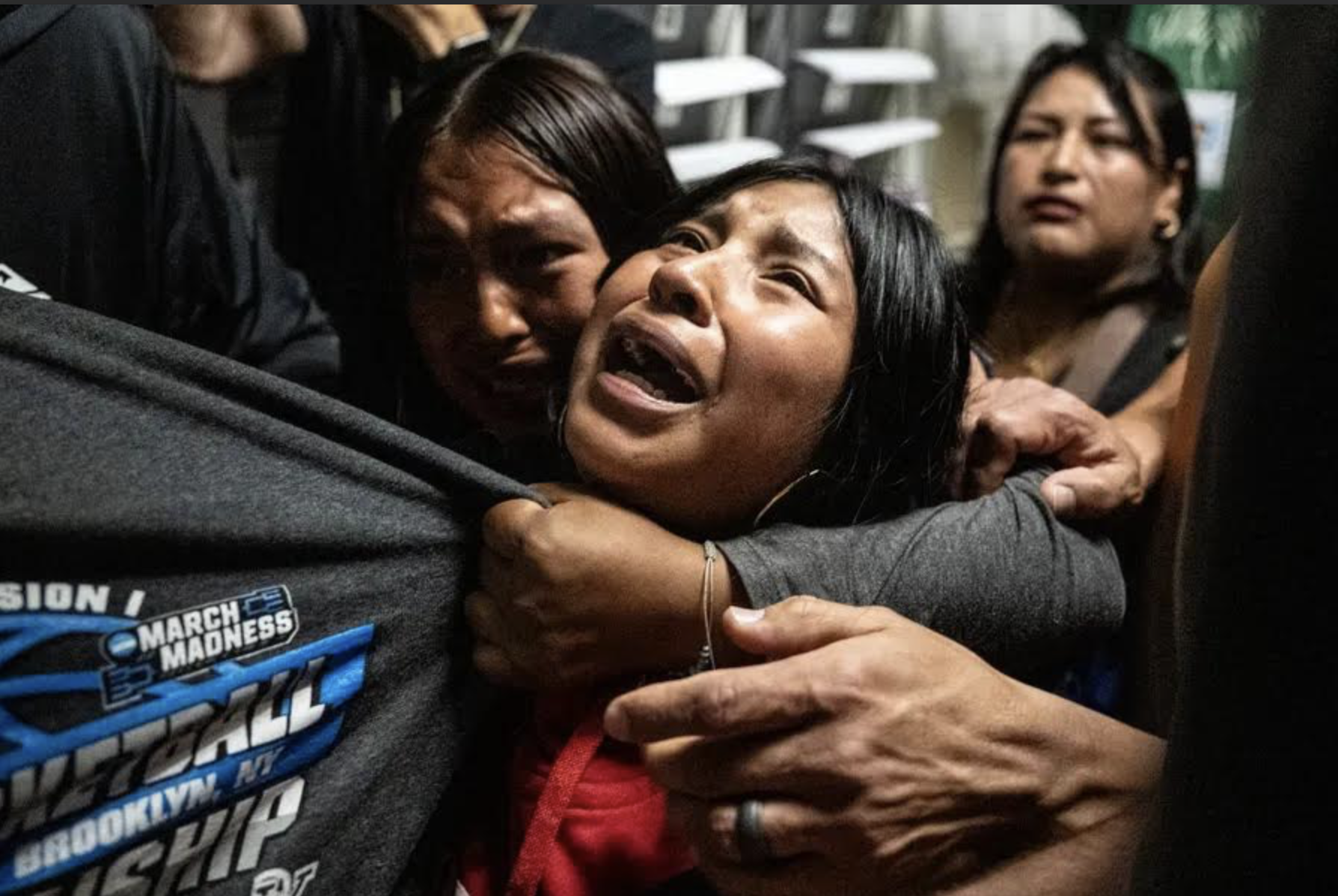
Photo by Stephanie Keith
“Give me your tired, your poor, your huddled masses yearning to breathe free.” In the city long associated with this very promise etched into the pedestal of the Statue of Liberty, migrants are increasingly left to navigate a system that has been stacked against them.
New York City has projected a steep decline in asylum-seeker spending—from $1.5 billion in FY 2026 to $500 million annually by FY 2028. This comes as a result of the Trump administration sharply reducing aid programs supporting migrant reception and legal assistance nationwide. Migrants now face immigration courts with fewer resources and little support. In New York City, where local organizations fill federal gaps, these cuts have placed heavy pressure on already overstretched nonprofits.
While working at the Catholic Charities Immigration Court Helpdesk at City Hall, I witnessed many migrants who were simply trying to follow the rules, but instead were met with confusion, fear, and limited access to information or support. That reality worsened when my entire floor was suddenly fired because of funding cuts under the Trump administration.
During my last hearing on the job, I worked on a case involving a father awaiting deportation who collapsed into my arms as he revealed the childhood sexual assault he had endured. He was a Venezuelan immigrant trying to appeal a deportation order, estranged from his children and living alone in the United States. His life was marked by gang violence, corruption, and coercion. He fled to the US in search of a life free from the gangs and abuse that once defined his life.
His tears were unlike anything I had ever seen. I broke protocol and embraced him at our last meeting. Before I could finish helping with his deportation appeal, we received news that our entire office had been fired, not by our supervisor, but by President Trump. I cannot find enough words to describe how that week capsized everything I thought I understood about being an American. I could not help him. None of us could help him, while the rest of the migrants in the courthouse were left alone, awaiting assistance.
Despite dwindling support inside the courts under the Trump administration, migrants are still expected to continue attending their hearings. Yet, even if they comply with the system, they can be met with detention by the Immigration and Customs Enforcement (ICE).
Last spring, half of all immigration court arrests in the United States took place in New York City alone. More specifically, New York City accounted for the highest number of courthouse arrests with 460 cases, representing approximately 19% of the total 2,403 identified arrests. ICE operations have become concentrated around the very courthouses where migrants report for asylum hearings. Some are even detained steps from the entrance, before they ever enter the courtroom. While these migrants are trying to follow the law, the systemic issues of ICE deployment prevents them from doing so.
In one of these courthouses, 26 Federal Plaza, ICE has confined more than one-hundred people in holding units of 215 square feet for weeks. Not only are these people living in severely inhumane and punitive conditions, but they have also been banned from any in-person legal visitation, private phone communications, and confidential exchange of documents. 26 Federal Plaza has become a chilling symbol of the Trump administration’s mass deportation policies. People are being arrested simply for showing up to their immigration hearings, trying to follow the rules. Examples like these court houses make clear how the system is actively working against those it is supposed to serve.
When migrants can’t make confidential calls, meet with their attorneys privately, or exchange documents safely, constitutional protections vanish. The First Amendment protects our ability to speak, to express ourselves, and to connect with others without government intervention. The amendment’s use of “person,” rather than “citizen,” has been interpreted by the Supreme Court to extend due process protections to all individuals within U.S. jurisdiction, including migrants, as affirmed in Yick Wo v. Hopkins in 1886. Due process protections extend to migrants, regardless of immigration status. However, for many migrants, that protection doesn’t feel real. When someone is caged and can’t even talk to a lawyer, let alone prepare for a hearing, the promise of due process means nothing.
These courthouses violate constitutional due process protections and undermine the principle of equal protection under the law. When people fear detention for simply appearing in court, the legal system disfigures into a tool of coercion. Above all, this sets a dangerous precedent in which the government restricts liberties, such as the right to legal counsel, whilst avoiding full constitutional responsibilities that criminal prosecution requires.
In the face of these risks, however, local action has emerged as one of the few immediate checks on federal overreach. When federal immigration enforcement hastened, Mayor Zohran Mamdani moved to restore New York’s “sanctuary city” title through Executive Order No. 13. He has moved to strengthen privacy protections, limited ICE activity on city property, and created a crisis response team across New York. His office handed out more than 32,000 “Know Your Rights” guides in multiple languages, helping people understand what to do if federal agents come knocking.
Alongside administrative policy, meaningful resistance to federal enforcement in New York depends on sustained public mobilization—equal to the grassroots energy that propelled his very election. Sustained public mobilization can mirror how volunteers and community organizations across the city work to fill gaps where the courts and federal agencies can’t.
In city accompaniment programs, volunteers walk alongside migrants to court hearings, protect them in ICE check-ins, and even help with everyday needs while their cases move forward. Beyond paperwork, work like this allows any individual to stand and lets them know they’re not facing this alone.
However, work like this does not come without risks. ICE has overstepped its legal authority, arresting people near courthouses and even during routine check-ins. Some volunteers have stepped back, worried for their own safety. Yet, the need for volunteers hasn’t disappeared—if anything, it’s more urgent than ever.
I saw this in my time with the Catholic Charities Immigration Court Helpdesk at City Hall. We served as lifelines for these marginalized communities. Volunteers help migrants make sense of the court process, explain what will happen in hearings, and assist with paperwork—from asylum applications to requests for work authorization. It might seem small, but for someone caught in such a confusing and intimidating legal system, it changes everything.
If unable to volunteer, remember the privileges given to you through the First Amendment: the right to speak, to watch, to record, and to share what we see. Only through its practice can we protect the rights our government has given us by holding them accountable. If we cannot serve, we must at the very least use the privileges we hold to fight for those most vulnerable in our country.
David Solano (CC ‘29) is a staff writer majoring in English, Economics, and Mathematics. He is interested in migration law.
Edited by Emelin Brito