
The Sky Is Free, But the Flight Isn’t
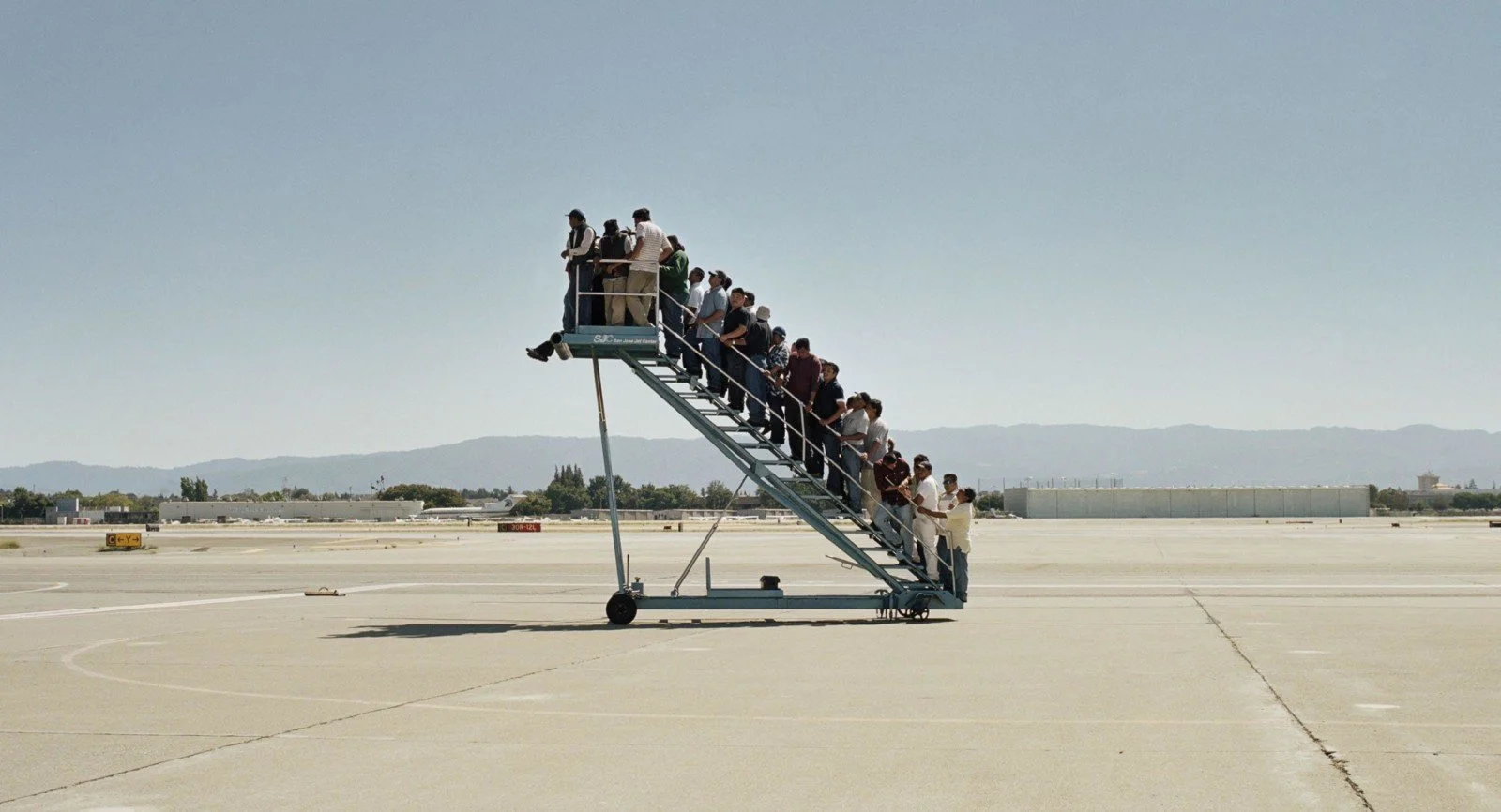
Adrian Paci – Centro di permaneza Temporanea, (Temporary Reception Centor) 2007, 16.9 video projection, color, sound, 5’30”
At convocation, we were told that our shade of blue—Columbia blue—was a sky blue, chosen to symbolize the limitless possibilities ahead for all of us. I remember my heart beating faster when I heard that. In a way, it is true—the sky here really does open boundlessly for everyone. But how we’re able to explore it is where everything changes. Some students arrive with planes—networks, confidence, the kind of social capital that lets them take off effortlessly, and, well, sometimes even literal planes. Others arrive with broken glass binoculars, able to somewhat see the horizon but without the same clarity or tools to reach it yet. I’ve realized quickly that we may be looking at the same sky, but not from the same altitude, not with the same momentum, and certainly not with the same equipment—and that difference quietly shapes the kind of burnout each of us will face.
Social capital refers to the relationships, cultural fluency, and insider knowledge that allow students to navigate elite spaces with ease; it isn’t money, but it often functions like a currency. Sociologist Pierre Bourdieu, for example, reminds us that social capital isn’t personality—it’s power. And that power is the distinction between what allows one to explore and understand what sociologist Anthony Jack explains as the “hidden curriculum”—unspoken rules about networking, confidence, and self-advocacy that some students inherit and others must learn overnight. That hidden curriculum is the very catalyst for this distinction in burnout.
For first-generation and low-income (FGLI) students, college is not a four-year intellectual exploration but a high-stakes investment whose returns must secure financial aid, internships, and future social mobility. Their time is split between learning a hidden curriculum they were never taught and earning the grades that function as their primary source of economic capital. Every hour spent trying to build social capital is an hour not spent studying or resting. Their burnout stems from scarcity across every dimension: money, time, institutional fluency, and margin for error. They must accumulate the social capital they arrive without while simultaneously excelling academically just to remain competitive. Affluent students, by contrast, are high in economic and social capital. They are backed by inherited networks. Their exhaustion comes not from survival pressures but from navigating an abundance of opportunities and connections. In a system that prizes visibility and relationships, wealthy students can burn out into opportunity, while FGLI students burn out simply to stay in the game.
However, Columbia College frames the Core Curriculum as a collective learning experience designed to spark community-wide dialogue and intentional reflection on classic works. The Core was originally founded with the intention to understand and examine “the insistent problems of the present.” For FGLI students, the Core serves as an attempt at leveling the playing field and easing FGLI burnout by handing us an intellectual foundation and boosting our social capital. In theory, it provides a language for us to use in networking receptions, alumni conversations, job interviews—a literate tool that should make us more “educated.” For many FGLI students, the Core doesn’t open doors; it narrows them. Courses built around Western classics insist on a particular kind of cultural fluency, a canon that affluent students often grew up rehearsing in small seminar-style classrooms long before college. Instead of feeling like an invitation, the Core feels like a quiet instruction: speak our language, adopt our references, learn our world before your own will ever be recognized here. What is framed as equalizing often functions as assimilation. Sure both wealthy and poor students can treat Core texts as talking points to deploy in professional rooms they were already entering, but the difference is that for FGLI students, they must first shed parts of themselves—dialects, stories, ways of knowing—in order to sound “prepared,” “polished,” or “professional.” The Core promises access, but often delivers an unspoken message: to belong in these elite spaces, your own cultural history must be superseded by ours.
The stakes are simple, students who never learn to question these disparities graduate into positions of influence believing the myth of equal opportunity is real because it was real for them. And once the institution teaches them to mistake privilege for merit, the cycle only deepens, causing not only student exhaustion, but a generation of leaders unable to see the planes they flew because someone else held the wheel steady. And in the meantime, this expectation creates—and strengthens—a social and professional toxicity within society that often FGLI students cannot replicate; therefore rewarding performance over authenticity and pressuring students to mold themselves into someone they’re not. And if we’re all forced into the same polished version of ourselves, then what is the point of learning at all if we’re destined to become copies instead of individuals?
I can’t fly, and I hate it. I still think about that sky blue from convocation—how confidently we were told it symbolized freedom, possibility, flight. But for whom? A prosperous sky means nothing if only some students have the equipment to reach it. An insistent problem of the present, then, is the unquestioned relationship to social capital in elite spaces. However, the truth is, Columbia doesn’t need to make the sky bigger; it needs to make flying a plane accessible. It needs to stop offering wings to those who already know how to fly while handing everyone else a manual written in a language they were never taught. That means offering real financial and time support so students aren’t choosing between sending money home and showing up to opportunity; providing culturally competent advice that understands the weight some of us carry; and creating classrooms where our histories aren’t erased but honored. Students like me aren’t asking for a plane. All we’re asking for is to also learn how to fly one—we’ll work to buy one on our own.
So you know what, yeah, I can't fly. Yet here I am, among the brightest and the wealthiest, so I refuse to wait for someone to give me a plane or teach me how to fly one. I’ll build one from scratch if I have to—hell, I’ll catapult myself into the sky before I let navigating this beautiful blue sky be reserved for the privileged.
The Review welcomes anonymous submissions. The author’s byline has been anonymized at the author’s request.