
Noem v. Vasquez Perdomo: The Erosion of Undocumented Immigrants’ Constitutional Rights
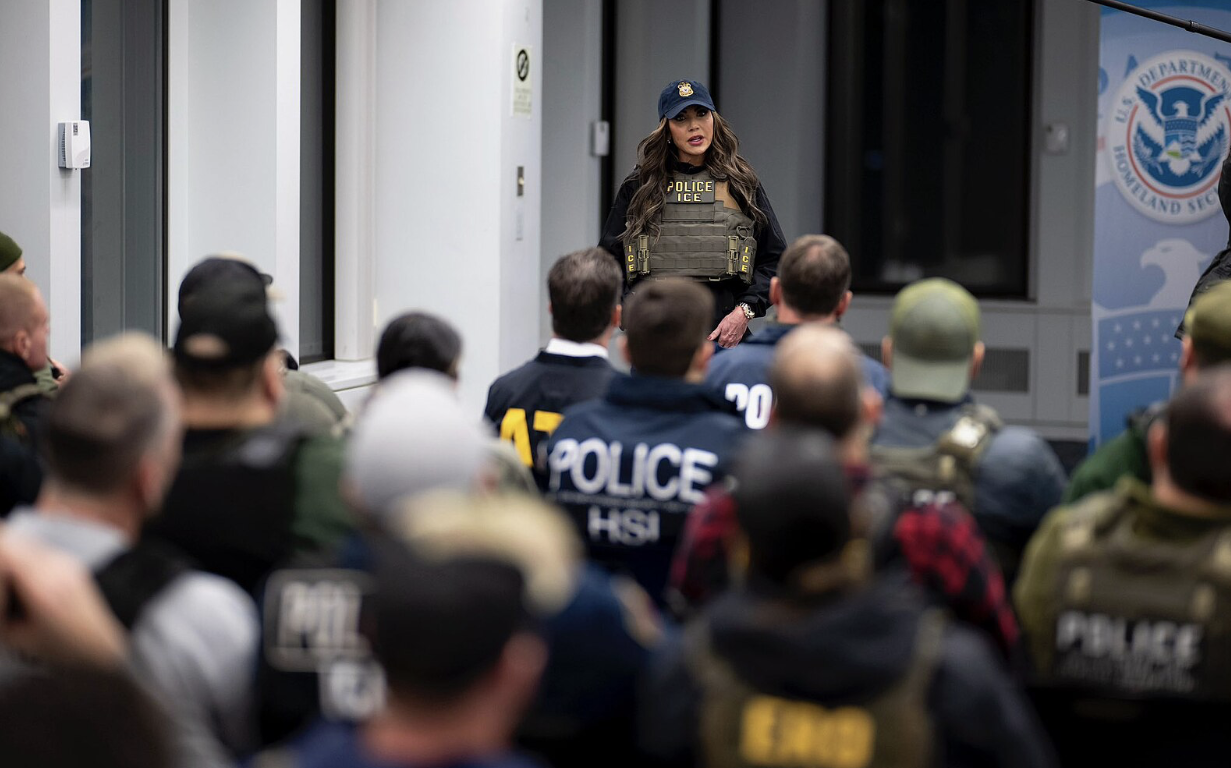
Kristi Noem overseeing an ICE enforcement operation targeting undocumented immigrants in New York City, 2025.

From simple traffic stops to everyday public interactions, undocumented Latinos today have to constantly worry about their daily activities because they have been cast as the villain within American culture. As a result of stigmatizing rhetoric used by President Donald Trump, Latino immigrants, regardless of legal status, have been portrayed as responsible for taking jobs, government resources, and breaking criminal laws. This racialized and anti-immigrant context helps explain the Supreme Court’s recent stay on Noem v. Vasquez Perdomo (No. 25A169) from its emergency docket. This case allows Immigration and Customs Enforcement (ICE) officers to consider factors such as accent, Spanish-speaking ability, and perceived ethnicity when initiating enforcement actions, raising serious constitutional concerns. Many people may question how this has become our reality, and one explanation is the increasing influence of moral values replacing legal secular reasoning in Supreme Court rulings. Recent legal and policy shifts reveal a troubling trend in which moral values increasingly override constitutional protections. Noem v. Vasquez Perdomo marks a dangerous escalation for undocumented Latino communities, transforming personal identity into a basis for suspicion and allowing the government to weaponize “American” values as a tool of discrimination. Rather than a neutral application of law, these developments show how belief, particularly religiously coded beliefs about American culture, is overriding constitutional rights through public policy.
In Noem v. Vasquez Perdomo, the Supreme Court acted through its shadow docket, granting an emergency stay of the U.S. District Court for the Central District of California injunction that had temporarily prohibited federal immigration officers in Los Angeles from relying solely on factors such as language, appearance, or stereotypical workplaces – such as construction sites and Hispanic restaurants – as grounds for immigration stops. The lower court found these practices violate the Fourth Amendment and amount to unconstitutional racial profiling. Without issuing a full opinion, hearing oral argument, and in a 6-3 vote, the Supreme Court has allowed the challenged enforcement practices to resume while litigation continues. The stay carries immediate legal consequences: immigration officers may use language, appearance, and ethnicity as permissible factors in initiating brief investigatory stops away from the border. In making this unprecedented decision, Justice Kavanaugh reasons: “under this Court’s precedents, not to mention common sense, those circumstances taken together can constitute at least reasonable suspicion of illegal presence in the United States.” Clearly, then, this stay was issued without articulating constitutional limits and instead on what Justice Kavanaugh framed as “common sense.” Justice Kavanaugh justified the stay by focusing on the government’s claim that it would be harmed if immigration enforcement were paused in California and by suggesting the government was likely to win the case later on. He therefore relied on what he called “common sense,” rather than clear constitutional limits, to allow a policy that effectively permits racial profiling to continue. In doing so, the Supreme Court accepted the government’s framing that these traits were contextual cues necessary for immigration enforcement instead of racial proxies that would be impermissible in criminal contexts. Justice Sotomayor’s dissent articulates the real-world consequences of this jurisprudence: “We should not have to live in a country where the Government can seize anyone who looks Latino, speaks Spanish, and appears to work a low wage job. Rather than stand idly by while our constitutional freedoms are lost, I dissent.”
This use of the emergency docket enables sweeping changes in immigration enforcement without transparency or judicial accountability. The result of a stay mirrors the Supreme Court's pattern of treating immigration enforcement as civil and outside of the full protections of the Fourth Amendment. In U.S. v. Brignoni-Ponce (1975), for example, the Court held that Border Patrol agents may not stop a vehicle solely based on a person’s apparent Mexican ancestry, emphasizing that race or ethnicity alone cannot justify a stop. Yet, in Noem v. Vasques Perdomo’s temporary stay, the court legally permits immigration officers to operate under a standard that would be unconstitutional in any other context given past legal precedents. For Latino communities, these implications mean that speaking Spanish or displaying these “foreign” traits may serve as a legal basis to be questioned by immigration officers. The ruling, therefore, marks a shift in immigration’s civil enforcement, where constitutional boundaries are pushed and found to be void for “administrative” processes.
Noem v. Vasquez Perdomo reflects a broader retreat from the constitutional principle of government neutrality. Under the equal protection doctrine, the state may not disproportionately burden a racial or ethnic group, nor may it rely on traits that are racial proxies. This principle also supported U.S. v. Brignoni-Ponce, where the Court held that “Mexican appearance” alone could never justify a stop, but did accept ethnicity to be one factor considered among “many.” That compromise was supposed to be a narrow exception, but it became the doctrinal opening that courts later expanded to become contextual cues that could be used in administrative proceedings. This shift emerged through a series of decisions that treated immigration enforcement as a civil domain deserving lower constitutional protections than criminal proceedings. Under this framework, neutrality becomes optional instead of required. The Court’s modern reasoning treats the intent to protect American values as sufficient justification for relaxing traditional constitutional limits. Once immigration enforcement was framed as a moral or cultural project rather than a legal one, characteristics like speaking Spanish and accented English could become enforcement tools. In the present, this case has translated into racial profiling becoming a policy in civil immigration enforcement.
A similar elevation of values over constitutional principles appears in Trump v. Hawaii, where the Supreme Court upheld the presidential proclamation restricting entry from several Muslim-majority countries despite clear evidence of anti-Muslim reasoning. The government justified the policy by invoking broad appeals to national security, cultural cohesion, and the need to protect “American values.” The Supreme Court accepted this reasoning without scrutiny and signaled a shift toward deferring to value-based narratives even when they conflict with the Equal Protection Clause, which is intended to prevent policies that discriminate against a protected class, like religion, from being enforced. The decision to uphold Trump’s anti-muslim policy marked a departure from precedent, demanding non-discriminatory justifications for government action affecting minority groups. By reframing a policy rooted in religious and cultural exclusion as a permissible defense of national identity, the Court validated a legal approach where constitutional protections can be overshadowed by appeals to tradition and moral order. This same logic appears in Noem v. Vasquez Perdomo, where traits of Latino identity are treated as indicators of a cultural threat instead of impermissible bases for government suspicion, reinforcing the trend where values are elevated above rights.
What Justice Kavanaugh describes as “common sense” in Noem v. Vasquez Perdomo functions as a license for discriminatory immigration enforcement, deepening fear within an already vulnerable population. Taken together, this shift matters because it undermines the Constitution’s role as a constraint on government power and replaces it with discretionary, value-based judgment. When the Supreme Court – the highest court in the U.S. whose job it is to protect civil rights – allows identity-linked traits such as language, appearance, or religion to serve as legitimate enforcement factors, it weakens the Equal Protection Clause and erodes the principle that constitutional rights apply equally to all persons, including undocumented people. By framing immigration enforcement as a moral project, the Court permits practices that would be clearly unconstitutional in a criminal context. For Latino individuals, these changes mean that ordinary expressions of identity, like speaking Spanish or having an accent, can now trigger state scrutiny without any judicial oversight.
The Court’s willingness to defer to value justifications signals a dangerous precedent: if constitutional protections can be relaxed whenever the government invokes national identity, then rights no longer function as guaranteed protections but as privileges dependent on belonging. In this framework, the Constitution ceases to protect against discrimination and instead becomes selectively enforceable, leaving minority communities especially vulnerable to state power exercised in the name of values rather than law.
Alejandra Ramsey, CC ‘28, is a Staff Writer majoring in Political Science and Philosophy. She is interested in immigration law, specifically analyzing the constitutional protections that are provided to immigrants.