
Exporting the Culture Wars: “Wokeness”as a Transnational Tool of Right-Wing Populism
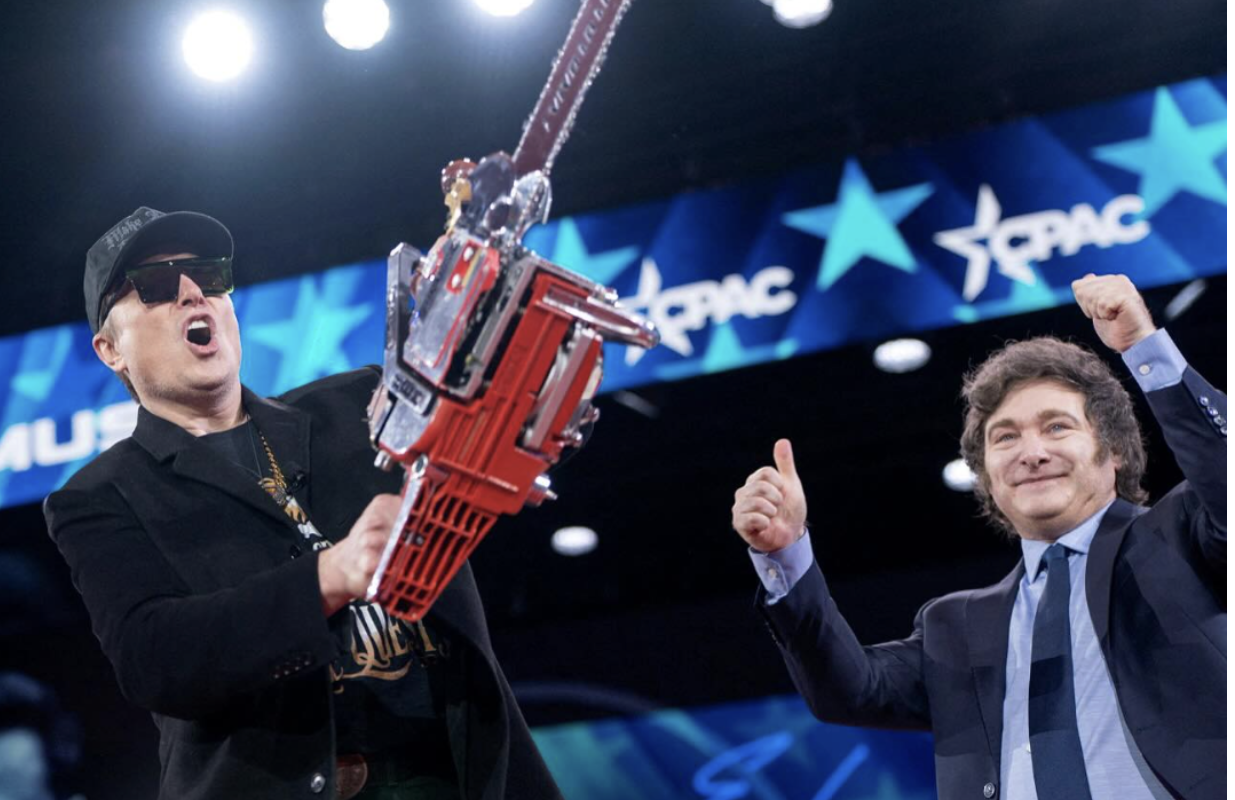
Elon Musk displays a chainsaw given to him by the President of Argentina, Javier Milei, during the Conservative Political Action Conference on February 20, 2025, symbolizing the cutting of government bureaucracy. Photography: Nathan Howard. Source: Reuters
In the United States, “wokeness” has become associated with progressive excess, identity politics, and moral decay, an all-purpose target in the ongoing culture wars. Originally a term rooted in African American activism and social justice movements, “wokeness” has been appropriated, redefined, and weaponized in political discourse, particularly within right-wing circles. Kentucky Attorney General Russell Coleman dedicates an entire section of his website to “Combatting Woke Ideology.” Tennessee Senator Marsha Blackburn touts efforts to make the U.S. military “less ‘woke,’” which, in her telling, includes refusing to respect pronouns. The New York Post offers “10 ways to fight back against woke culture,” in which the author, Bari Weiss, claims that “making mistakes and taking risks” is now treated as a “capital offense.” Rather than linking this heightened scrutiny to the culture of mass surveillance fostered by the war on terror and the rise of social media, she blames a vaguely defined “woke culture.” Ironically, Weiss herself is a staunch proponent of the war on terror. Such claims make clear that these actors are not critiquing “wokeness” so much as constructing a caricature of it. One broad enough to attack everything, from diversity trainings to Critical Race Theory, which Blackburn absurdly describes as assigning “racial significance to objectively neutral concepts like history.”
Yet what is often overlooked is how this American political vocabulary has traveled south, shaping discourse in Latin America and influencing the rise of right-wing populist leaders. Across the region, “wokeismo” has become a borrowed rallying cry, deployed much like its U.S. counterpart: a vague but powerful insult used to discredit social policies aimed at reducing class, gender, and racial inequality. By analyzing the extent to which American cultural debates over “wokeness” and identity politics are reflected in the rhetoric of right-wing populist leaders in Latin America, we can begin to comprehend this transnational phenomenon. Through these transnational networks, figures like Argentina’s Javier Milei, Brazil’s Jair Bolsonaro, and El Salvador’s Nayib Bukele have reshaped and exported these narratives, creating a feedback loop that links the political cultures of the United States and Latin America.
In the U.S., culture-war politics have increasingly replaced substantive policy debates. Most notably, the recent attacks on transgender women participating in school sports. Vaguely-defined terms dominate headlines, mobilizing voters around crude claims of morality and national identity rather than material concerns. Many Latin American leaders have eagerly drawn from this playbook. In Ecuador, President Daniel Noboa projects a Trump-style persona through his social-media savvy, pro-business outlook, and contrived “anti-establishment” image (both Noboa and Trump are the sons of enormously wealthy business magnates). In Brazil, Jair Bolsonaro’s denunciation of “gender ideology” echoed American evangelical rhetoric, illustrating how U.S culture-war language travels transnationally to legitimize authoritarian appeals under the guise of moral defense. Similarly, Argentina’s Javier Milei’s crusade against “cultural Marxism” allows him to frame opponents of his austerity agenda as “filthy lefties” intent on destroying civilization, effectively transforming economic dissent into an existential cultural threat. In El Salvador, Nayib Bukele’s projection of himself as a populist reformer “saving” his nation from moral and institutional decay through mass incarceration reflects the same “law-and-order” rhetoric used by American right-wing populists to justify the erosion of civil liberties. In each case, imported culture-war narratives are localized and adapted to the region’s own sociopolitical and cultural contexts.
This phenomenon is not merely an imitation of American politics but a transformation of the same. As these narratives circulate, they generate a globalized language of resentment and moral urgency that transcends borders. The consequences are profound: by reframing political debates around culture and morality rather than material conditions, populist leaders can deflect responsibility for economic stagnation, inequality, or corruption. The demonization of progressive movements and their representatives—whether they are prominent feminists, journalists, or indigenous rights activists—has become a tool for consolidating power and silencing dissent. Simultaneously, right-wing politicians in the U.S. often celebrate leaders like Milei or Bukele as icons of “anti-woke” resistance, integrating their rhetoric back into American debates. This feedback loop of culture-war populism aids in strengthening the reactionary agenda of right-wing oligarchs in the hemisphere.
By casting progressive political and social movements as the product of pernicious mind viruses such as “wokeness,” leaders obscure the real social inequalities that drive these movements, instead portraying identity and moral purity as the primary political fault lines. The struggles of economically marginalized communities are treated as non-existent, with politics reconstructed as an existential conflict between morality and degeneracy. Immigrants are demonized as parasites leeching off the resources of the host, and the very existence of LGBTQ+ people is treated as a surefire sign of nation-wide moral decay. In times of economic uncertainty and social fragmentation, this serves to redirect the hostility of segments of the population towards “otherized” groups, rather than the greed of economic elites that these right-wing narratives serve.
Tracing these patterns across the Americas reveals that right-wing populism today operates through a shared transnational language. U.S. debates about “wokeness” inspire Latin American leaders to weaponize cultural grievances in their own contexts, while those same leaders influence global political discourse by re-exporting localized versions of American culture wars. This recursive exchange not only erodes democratic norms but also redefines what populism means in an interconnected world, one where political rhetoric moves faster than policies, and the culture war becomes both the message and the means of control.
As polarization intensifies from Washington to Buenos Aires, and as right-wing leaders continue to manipulate identity and morality to their advantage, examining the shared language of right-wing politics is no longer optional. It is essential for anyone seeking to understand the future of democracy in the twenty-first century.
Patricia Lynne Bessie, CC’26, is a Staff Writer majoring in Political Science and Public Health on the pre-law track. She is particularly interested in the intersection between education and subsequent health outcomes, and hopes to explore these interests further post-graduation.