
Now people care about Venezuelan sovereignty, oil, and freedom?
Neomar Lander was seventeen when he was killed during a peaceful protest in 2017. His death was documented. It was denounced. It was included in reports. And then it was ignored. No one has ever been held accountable—not by Venezuelan courts, not by international bodies, not by the institutions meant to defend human rights. Before he died, Neomar said: “The struggle of a few is worth the future of many.” Eight years later, his words endure—not because justice prevailed, but because it never arrived.
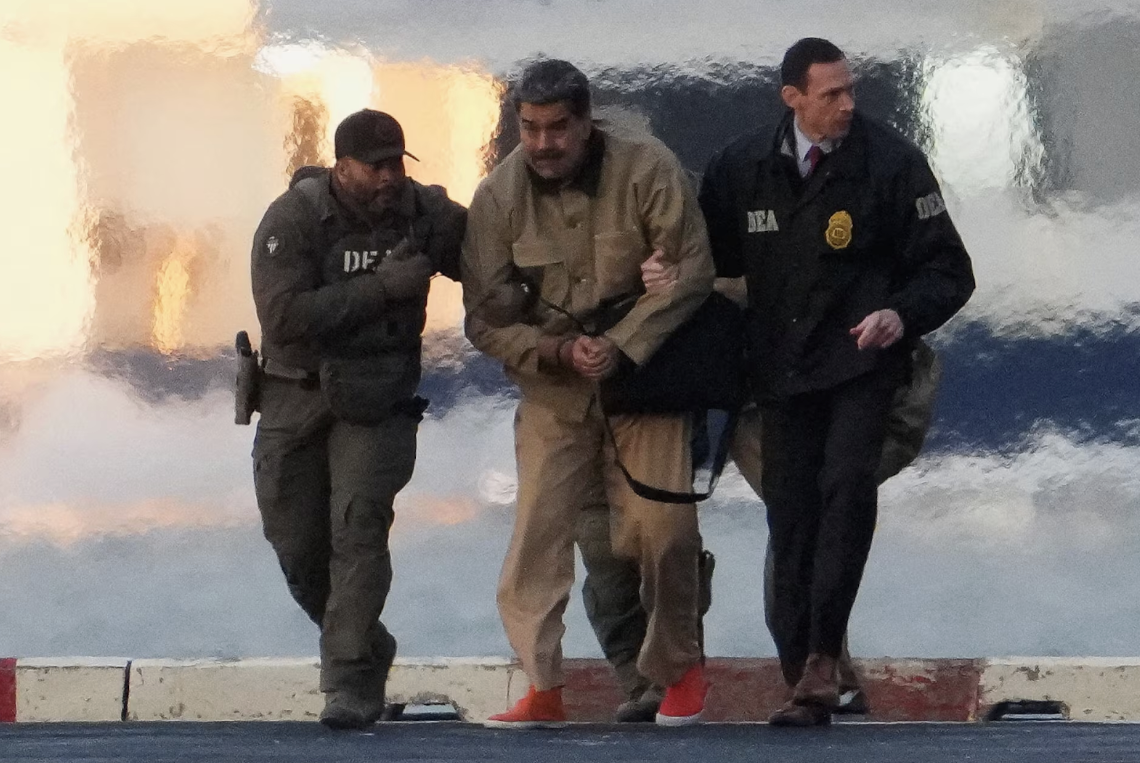
The U.S. military extraction of Nicolás Maduro in the early hours of January 3rd, 2026, did not come after a crisis. It came after decades of the world turning a blind eye to what Venezuela has endured.
Venezuela has been captured by a repressive, dictatorial regime for more than twenty-six years. Nicolás Maduro’s government bears sole responsibility for where my country stands today. What happened on January 3rd did not occur in a vacuum. It followed years of international law failing to act against a regime responsible for thousands of political prisoners, documented crimes against humanity, and proven criminal and narcotrafficking ties at the highest levels of power.
Foreign military extractions are not what Venezuelans imagined when we spoke of a democratic transition. We did not hope for force. We hoped—perhaps naively—that the 2024 elections would be free and fair, and that the will of the majority would be respected. We hoped the world would recognize what Venezuelans already knew: that María Corina Machado was the leader our country chose and Edmundo González President-elect.
We hoped international actors would care about our sovereignty from Cuba, China, Iran, and Russia before January 2026, not after.
We hoped that international organizations would act on the students killed while protesting peacefully, on the evidence of torture, and on the systematic repression. We hoped the ICC, or the United Nations’ fact-finding mission, would bring consequences. Instead, what we received was silence. And silence, over time, becomes complicity.
During the 2025 Nobel Peace Prize ceremony honoring María Corina Machado, the Chair of the Norwegian Nobel Committee stressed that activism under dictatorship is not judged by moral purity, but by constrained choices. As he noted, people living under authoritarian rule are often forced to choose “between the difficult and the impossible,” while outsiders, from a safe distance, demand standards they themselves have never faced. Democratic leaders under repression, he argued, “must choose paths that are actually open to them, not retreat into wishful thinking”. This is precisely where Venezuela was driven.
Dialogue, meanwhile, was not absent in Venezuela; it was abused. In authoritarian systems, it can function as a trap—used to buy time, divide the opposition, and maintain control while repression continues. This is how the Norwegian-mediated talks and the Barbados agreements were repeatedly signed, internationally celebrated, and then systematically violated by Maduro’s regime.
What we saw in the early hours of January 3rd is not ideal. But it is what we are dealing with now. Democratic transitions are slow, painful, and often deeply imperfect. Sometimes they unfold while sitting across the same people who inflicted immense harm. That reality is uncomfortable—but it is real. And it is precisely where Maduro’s dictatorship drove us.
To those condemning January 3rd from a position of moral purity, I ask for humility.
Condemnation is easy when it comes from the privilege of living in a safe democracy. What those critics often fail to understand is that Venezuelans tried every other peaceful and democratic option for years. We voted—and had our victory stolen. We did the impossible by proving electoral fraud to the world within twenty-four hours. We sat down with international observers and signed agreements that the regime never intended to honor.
Do not mistake our celebration for blindness. Do not tell us to “read a history book,” or reduce this moment to crude claims that “the U.S. only did it for oil.” That rhetoric underestimates our ability to think critically about our own country. It is not analysis; it is condescension. We are not naïve. We understand the uncertainty that follows this moment. We would have preferred Maduro to step down in 2024, through elections that were clearly won and clearly documented. But that path was closed by the dictatorship.
I am willing to engage in serious discussions about the legal implications of what occurred. Those debates matter. But they should not be written from a superior moral stance that looks down on Venezuelans celebrating the incarceration of a dictator, nor reduced to party lines. Venezuelans do not support this because it was easy. We do so because every other path was made impossible. We do so because we want to offer justice to Neomar Lander’s mom and for the thousands of families affected by similar acts of authoritarian abuse.
We are ready to do the harder work: ensuring the Venezuelans’ will is respected and that we rebuild our freedom.
Gabriel Ferrer, Harvard ’26, is a Venezuelan undergraduate student concentrating in Economics and Political Science. His work focuses on Latin American politics, political transitions, and recent Venezuelan democratization efforts.