
Has the Colombian State Made Peace with its Rural Population?
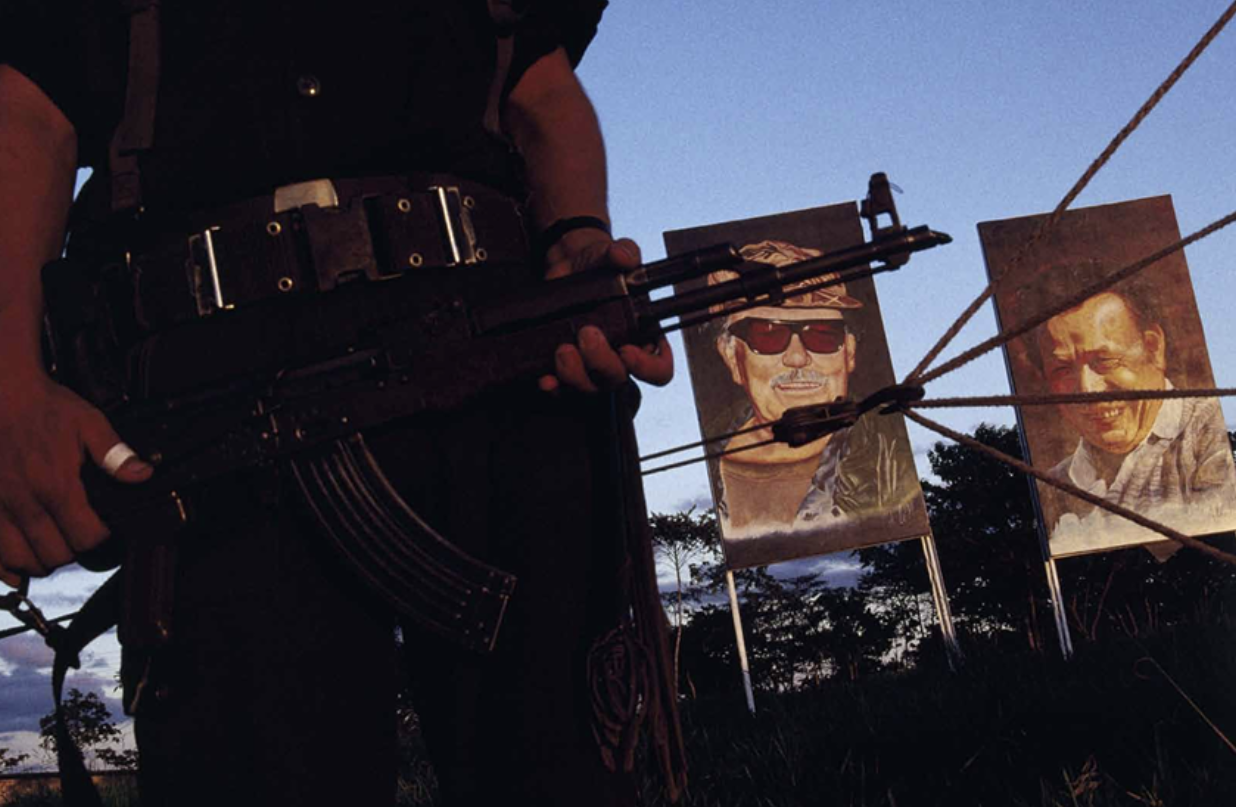
“FARC headquarters, during failed negotiations. signs in background portray founders of the FARC (L-R): Jacobo Arenas, Manuel Marulanda. Los Pozos, Caquetá. September 5, 2000.” Unknown photographer. Photo courtesy of the Violentology Project at Yale University.
Celebrated for supposedly ending fifty years of kidnappings, forced internal displacement (FID), and endemic violence, the 2016 Peace Agreement between the Colombian government and the Revolutionary Armed Forces of Colombia–People’s Army (FARC-EP or FARC) drew tremendous international attention. The agreement won Former President of Colombia, Juan Manuel Santos, a Nobel Peace Prize for his “resolute efforts to bring Colombia’s 50-year-long civil war to an end.” He was applauded during his Nobel Lecture as an example of disarmament and reintegration that prioritized victims’ agency. Beyond a ceasefire for all parties, the Colombian government also committed to pursuing rural reform, economic alternatives to illicit drug trafficking, justice for victims, and political representation and participation for ex-combatants. Nearly ten years after the FARC-EP laid down its weapons however, a concerning portion of initiatives the state offered in exchange remain unrealized. The government has dragged its feet in implementing rural reform, particularly in its Rural Development Projects (PDET) meant to address the socioeconomic inequalities between urban and rural areas in the country. Violence in Colombia is on the rise, and the areas that once had the greatest FARC presence continue to be the most vulnerable. This delay is not incidental negligence. It is the Colombian government failing to hold up its end of the bargain. The asymmetrical implementation points to deeper injustices common to governments like Colombia’s—with high numbers of landowning oligarchs since colonial times—suggesting the country needs deep structural changes to deliver on its promise of agrarian reform.
Fifty Years of Conflict
The FARC was officially formed in 1964 with the goal of overthrowing the Colombian government in pursuit of sociopolitical transformation. In the face of government neglect, land inequality and dispossession, farmer communities in the rural south resorted to autonomy and self-protection. These left-wing farmer enclaves or “independent republics” were perceived as a threat by the Colombian government, which had just formalized the derecognition of all but the Liberal and Conservative parties to form the National Front in 1958. In response, the Colombian government launched the US-backed Operation Marquetalia, in May of 1964, attempting to dismantle one such enclave by the same name, but was met with local armed resistance. Fifty farmers that delayed Colombian troops from entering the village of Marquetalia soon after adopted guerrilla tactics and mobilized towards government overthrow. So were born the Revolutionary Armed Forces of Colombia, closely followed by the Army of National Liberation (ELN) and other guerrilla groups such as the M-19 and EPL.
The following decades saw endemic violence between left-wing guerrilla groups, the Colombian military, and by the 1980s included far-right paramilitary groups collaborating with wealthy landowners, business leaders, government officials and drug cartels. According to the July 2013 report of Colombia’s National Historical Memory Center (CMH), between 1958 and 2012 the conflict had an estimated 220,000 fatalities, over 80% of which were civilian deaths. Paramilitary groups quickly became the deadliest actors. Of the 1,982 massacres documented between 1980 and 2012, paramilitary groups carried out 1,166, or 58.9% of them, and at least 20 massacres were likely collaborations between military and paramilitary groups, while guerrilla groups were responsible for 343. For every massacre perpetrated by guerrilla groups, the paramilitaries carried out three. Human Rights Watch also found that paramilitary groups regularly “coordinated with [Colombian] soldiers in the field, and [were] linked to government units via intelligence, supplies, radios, weapons, cash, and common purpose…effectively constitut[ing] a sixth division of the army.” The extent of their collaboration means the Colombian military was largely responsible for the damage caused by paramilitary groups.
The devastating legacy of the conflict can also be seen in its incidents of forced internal displacement (FID). Beginning in 1999, The Registry for Displaced Populations (RUPD) received reports that would total 2,452,152 forcibly displaced people by 31 March 2008. However, an estimated 30% of cases were unreported, meaning it is likely that over 3.5 million, 7.8 percent of the national population at the time, was forced to leave their homes. Of course, FID in Colombia extends decades before 1999 and continued long after. Since the start of the conflict, FID most often affected rural communities and farmland, with people abandoning their homes in response to direct threats, homicide, disappearances, torture, sexual violence, forced recruitment, massacres, kidnappings, armed confrontation, or eviction notices. However, a report hosted by the World Justice Project also concluded that private and paramilitary economic interests are what prevent internally displaced people from returning home: abandoned lands are often taken over by large corporations and transfers of titles are frequently forged or signed under duress. Together, massive land inequality, economic interests, and the government’s neglect of rural areas, and collaboration with paramilitary groups can be considered primary drivers of the armed conflict.
Peace Agreements
There were a number of successful peace negotiations between guerrillas and the Colombian government in the 80s and 90s, and, by 1991, portions of the ELN and EPL, as well as the entire M-19 had demobilized. But it was not until 2016 that the FARC signed. The Final Peace Agreement was not simply a ceasefire. It hoped to address the FARC’s actions as political and offer dignity to the victims by committing the government agrarian and political reform and ensuring a proper investigation into the crimes of every actor.
The agreement is organized into 6 points: ‘Land and Rural Development;’ ‘Political Participation;’ ‘End of the Conflict;’ ‘Illicit Drugs;’ ‘Justice for Victims of the Conflict;’ and ‘Implementation and Verification.’ ‘End of the Conflict’ describes the plan for a gradual disarmament process wherein former combatants would move into UN monitored camps and lay down their weapons. ‘Political Participation’ details the promise of five seats in both the House of Representatives and the Senate until 2026 for the FARC, now a political party called the Common Alternative Revolutionary Force. ‘Illicit Drugs’ commits the FARC to cease their drug trafficking and help farmers transition away from coca farming. ‘Justice for Victims of the Conflict’ lays out the terms of transitional justice, which comprises a Special Jurisdiction for Peace (JEP) able to give out alternative sentences to former combatants, as well as a Truth Commission and a Special Unit to Find Missing Persons (UBDP) that together investigate and memorialize the true harm caused to victims of the conflict.
‘Land and Rural Development,’ the first point of the agreement, is the government's largest structural and economic commitment to restoration and the country’s best chance at addressing the unjust conditions under which the conflict began. It aims to reduce inequalities in land ownership, halve poverty over its fifteen-year implementation period, and eradicate extreme poverty. To achieve this, the agreement proposed mechanisms to secure land access for peasant farmer communities, strengthen land-use planning through instruments such as a multipurpose cadastre, and resolve land conflicts through a Special Agrarian Jurisdiction. It also stipulated the Rural Development Projects (PDETs) to promote economic transformation in municipalities most affected by the conflict.
Implementation
Progress has been slow and unequal, despite the sweeping promises. Seven years in, only 32% of the accord’s terms had been completed, while 49% remained in progress or untouched. Crucially, Comprehensive Rural Reform (‘Land and Rural Development’) remains among the least implemented provisions, with only 9% of promises considered ‘complete’ and 70% only minimally underway in November of 2024. Comparing rural reform to the third point, ‘End of the Conflict’, concerned with disarmament and demobilization of the FARC, which was 50% complete in 2024, there is a clear asymmetry in the compliance of the two parties involved with the terms of the agreement.
Unsurprisingly, violence is still high, FID continues, and economic conditions for the poorest districts have not improved. After the ceasefire, around 1.5 million more people have been internally displaced, with over 260,000 displaced in 2024. Municipalities that had the greatest FARC presence prior to the agreement have seen the least significant reduction in FID since the ceasefire took effect. Given that these areas have been the most vulnerable, it is reasonable to assume that this discrepancy is related to the delays in rural reform initiatives. A 2024 London School of Economics study on the economic effects of the Colombian peace agreement shows “economic indicators did not improve in areas previously affected by the FARC (if anything, the only significant coefficient is actually negative, on value added per capita)” since the signing of the peace agreement. Possibly the most disturbing failure of the agreement's implementation are the preserved ties with paramilitary groups. In their General Country of Origin Information Report on Colombia, the Dutch government found “reported contact between neo-paramilitary organisations and elements of the Colombian security apparatus (police and military),” with widespread bribery for information, patrol cooperation, and acquiescence to drug trafficking. Thus, much of the 2016 peace deal with the FARC appears mute without equal efforts to eradicate neo-paramilitary activity.
Discussion
Nearly a decade after a historic ceasefire and peace agreement, the continuance of violence and forced displacement in Colombia reflects the state’s failure to implement comprehensive rural and economic reform, without which the conditions that motivated armed groups remain intact. Further unresolved is the legacy of state collaboration with paramilitary forces, whose economic interests drove displacement and land dispossession and whose tactics were the most deadly. Without material agrarian reform and a definitive break between state institutions and paramilitary violence, peace in Colombia remains tenuous.
Here, the Colombian government is confronted with a difficult ethical dilemma: navigating the tension between justice and legality in disputes over land ownership and property titles. Many forcibly displaced people legally handed over their land to wealthier landowners—often with paramilitary ties—before fleeing their homes. The official transference of ownership often bars the government from easily returning land to displaced people. It is a difficult legal task to follow the strings of duress. A signature can be pointed to for longer than the fear in which it was written. Yet only by questioning the justice of legally valid land transfers made in the height of threats and violence can Colombia hope to keep its ambitious promises of rural reform through land restitution. The first point of the Peace Agreement therefore depends on uncovering and memorializing exactly what happened in the Colombian countryside, the stated goal of the Truth Commission.
The FARC has its origins in groups that were abandoned by the government that then lost its legitimacy in their eyes. To regain that legitimacy and restore Colombia’s social contract, it is imperative that the Colombian government be willing to distinguish between the letter of the law and the older, messier demands of justice. This distinction requires asking who wrote these laws, whose interests they protect, and whose they neglect.
Violeta Reyes, CC’28, is a Staff Writer majoring in Philosophy. She is interested in social contract theory and the legacy of colonialism in land ownership and wealth inequality.