
The Power of Rhetoric: ICE, Dehumanization, and Immigration Law
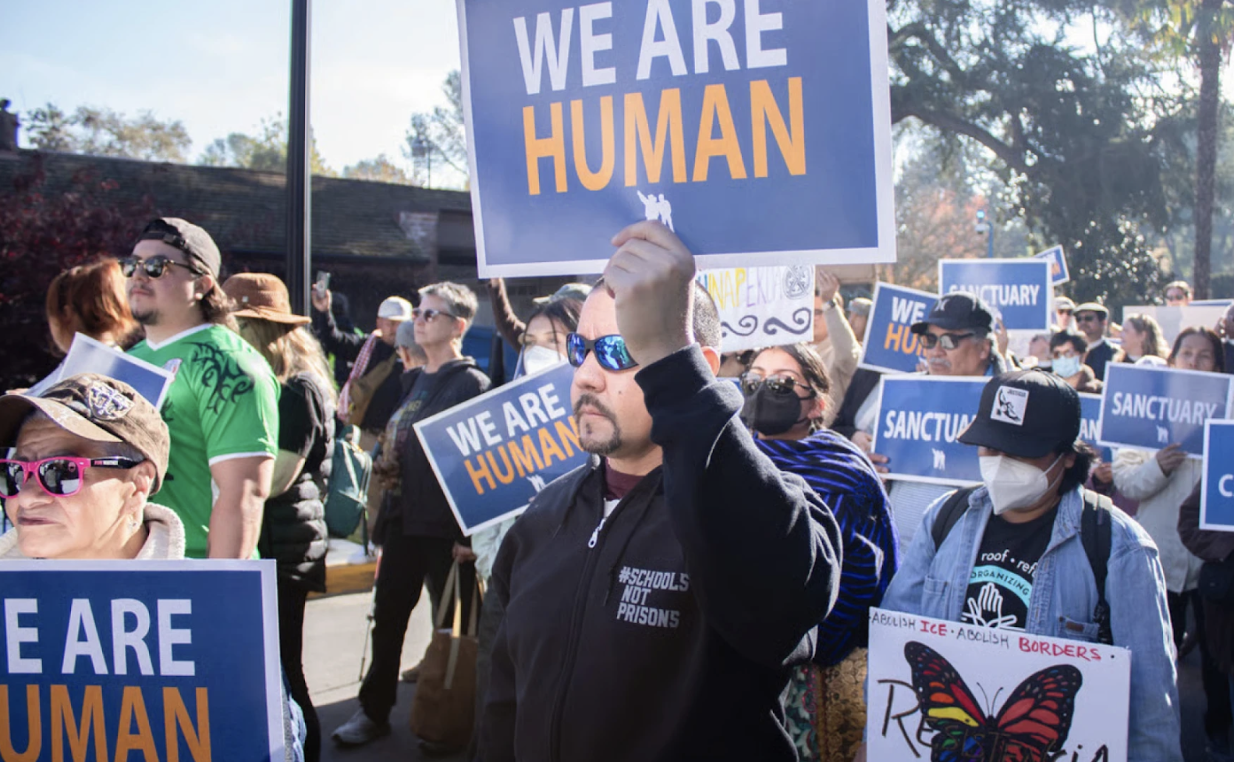
Immigrant rights advocates and allies gather for a rally on Monday, December 2, 2024, at the State Capitol in Sacramento.
ICE arrests have increased by 627% since 2024, a shift that has heightened both public opinion and judicial scrutiny of immigration enforcement practices. These arrests are cruel, harmful, and violate the human rights of detainees, especially Latinx people. In fact, NPR reported that 20 people detained by ICE have died in custody in 2025. However, the ongoing mainstream discourse about ICE raids often fails to mention the underlying root cause and belief systems that legitimize these human rights violations. Specifically, the root cause is an inherent prejudice against immigrants. Within this framework, immigrants are not human; therefore, perpetrators feel comfortable disregarding immigrants’ human rights.
As both a descendant of Holocaust survivors and a Latinx person, the issue of human rights violations is not foreign to me. However, this is not merely an ICE enforcement or national security issue. It is about the reproduction of harmful ideals that legitimize rhetoric fostering prejudice, stereotypes, and negative attitudes toward immigrants. The question then arises – why does this matter?
There is a historical precedent that illuminates the danger of rhetoric that delegitimizes the humanity of a social group. Take the Holocaust, an event that occurred less than a hundred years ago, and the pain of which is still rippling down my family line. The Holocaust is an example of mass and intense violence being perpetrated on certain groups of people by another group. These acts of mass terror are often studied, as the question centers around understanding the underlying drivers that trigger such inhumane acts. Landry et al.(2022) explain that the language used in the Nazi propaganda affirms a long held belief: that “dehumanization [...] is a precursor to mass violence.” They found that Jews were described as lacking distinctly human functions in the lead up to the Holocaust. In doing this, Nazis were able to perceive Jews as being lesser beings, different from them, and as possessing less consciousness and human traits. These distinctions are important because they reveal the dangers of rhetoric that promotes the delegitimization of one’s humanity, leading to one group dominating another and enacting harm upon them.
In the context of current immigration discussions and policies in the US which mainly focus on Latinx people, this is, too, very relevant. The danger of contemporary ICE enforcement practices lies in its reliance on the same dehumanizing logics that historically made genocide possible. ICE raids normalize the treatment of Latinx migrants as disposable and criminalized bodies, echoing the early stages of dehumanization identified in Holocaust scholarship.
Moreover, the Supreme Court, through an emergency stay, permitted ICE officers to question undocumented suspects solely based on their “apparent race or ethnicity,” speaking Spanish or accented English, and places where undocumented immigrants “are known to gather” in Noem v. Vasquez Perdomo. This stay is pertinent, as it is a very powerful representation of the dangers of the current dehumanizing rhetoric surrounding undocumented immigrants from the US Government and specifically targeting Latinx people. It shows how when a group is both repeatedly dehumanized and denoted as an inherent danger, their mere right to exist is seen as invalid. In sanctioning enforcement practices that single out Latinx individuals for intrusion based on race-associated characteristics, the ruling implies that their freedom and right to exist in public space are conditional. Further, because such encounters may escalate into detention, and given the well-documented violence and abuse within ICE detention facilities, the decision exposes undocumented immigrants, or those suspected to be, to increased risks of harm. Noem v. Vasquez Perdomo contributes to the current discourse surrounding immigration law because it was resolved through the Supreme Court’s emergency docket, allowing enforcement practices to take effect without full merits briefing, oral argument, or a reasoned majority opinion. As a result, significant constitutional questions regarding racial profiling and Fourth Amendment protections were provisionally resolved outside the Court’s ordinary deliberative process.
It becomes clear that dehumanizing and vilifying immigrants is dangerous not only because it makes violence towards them more likely, but also because it challenges our understanding of the law – redefining it from a doctrine protecting rights into one that permits racial profiling in immigration policy.
This increase of dehumanizing rhetoric about Latinx people, coupled with the legal precedent set by Noem v. Vasquez Perdomo and the actions and potential violence such rhetoric enables, is made even more concerning when turning back to the not so dusty pages of history. Looking back at the Holocaust, it becomes evident that the terror inflicted on immigrants and specifically Latinx people, including the deaths of ICE detainees, is only the beginning of the dangerous consequences produced by dehumanizing rhetoric and subsequent violence.
So, to prevent this violence from escalating, we must first put an end to the rhetoric justifying it: the idea that Latinx and other peoples are less human. One of the most efficient ways of halting the proliferation of certain ideas is to prevent those who believe in them from obtaining a larger platform, such as through governmental positions. Thus, to dismantle these ideas of dehumanization which perpetuate real harm, we must remain vigilant and aware of the beliefs held by those we platform. Although the US presidential election and most mayoral races have culminated, many local elections are still occurring. Though seemingly miniscule, results of local elections can determine whether or not your local government will bolster this dehumanizing rhetoric and cooperate with ICE – a decision with grave consequences in this present political climate.
Sofia Freitas, CC ’29, is majoring in Philosophy. She is interested in what it means to be human and how such ideas are interpreted in society, particularly under the guise of ethnicity.